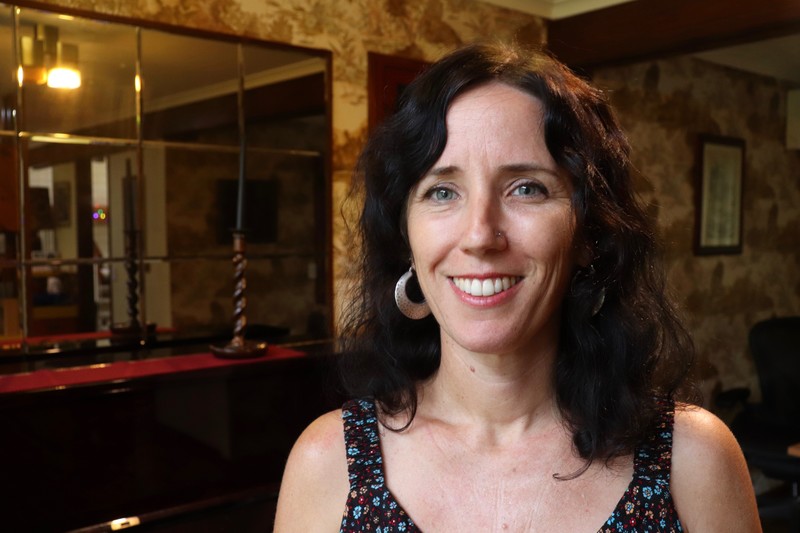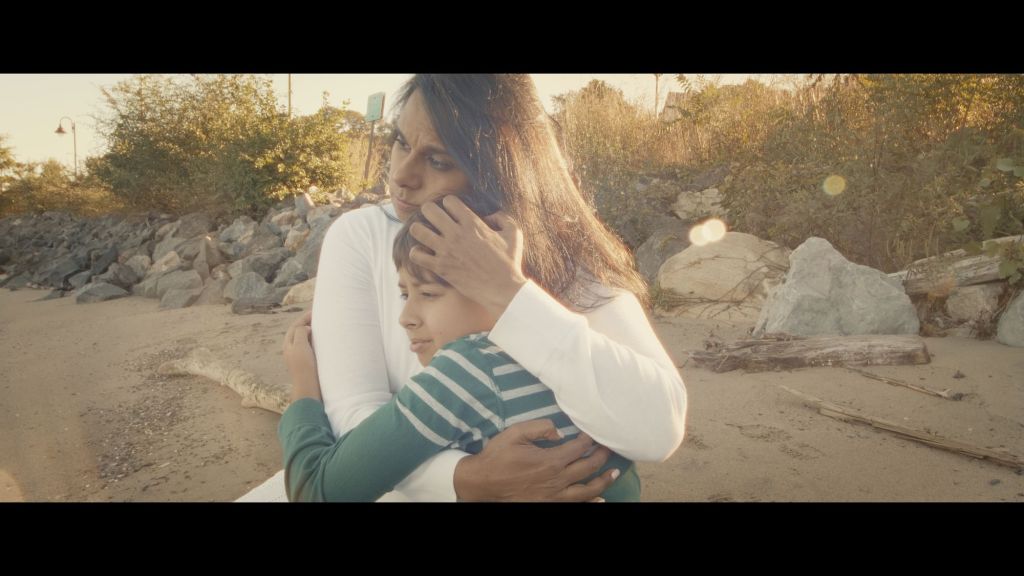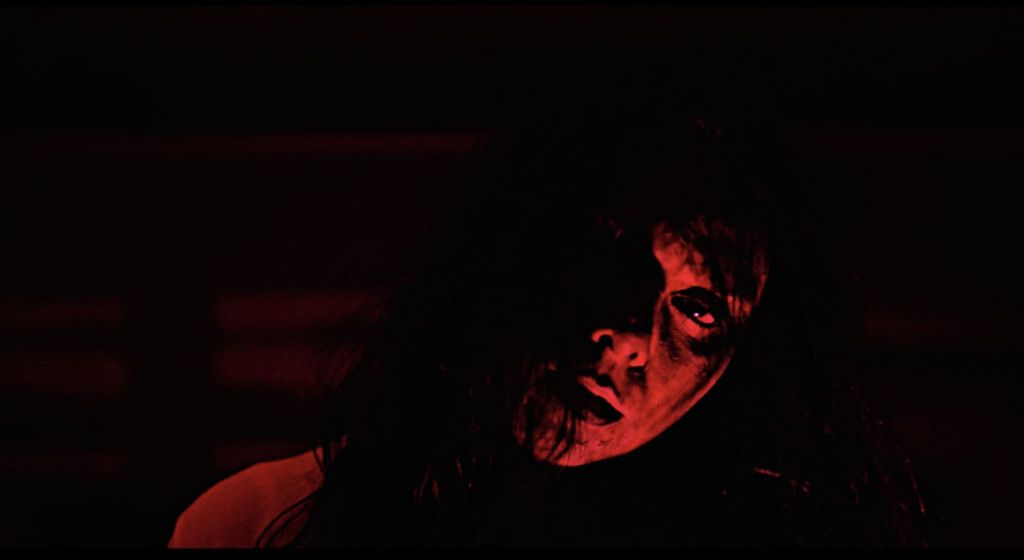
Interview with Clare Macdonald, Director of ‘The Mountain’

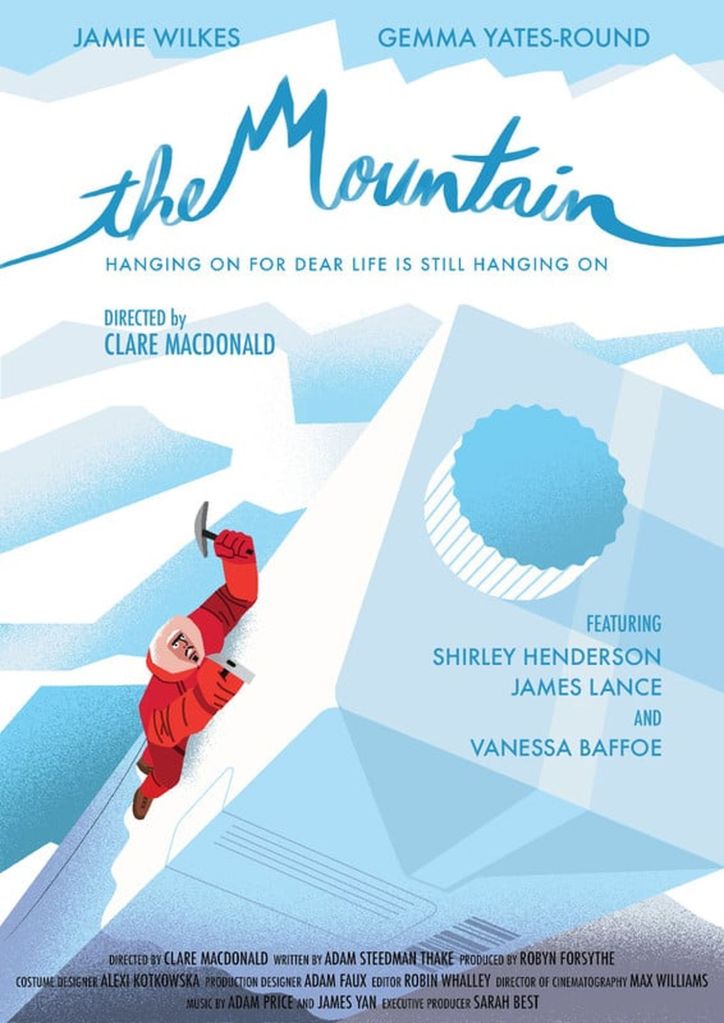
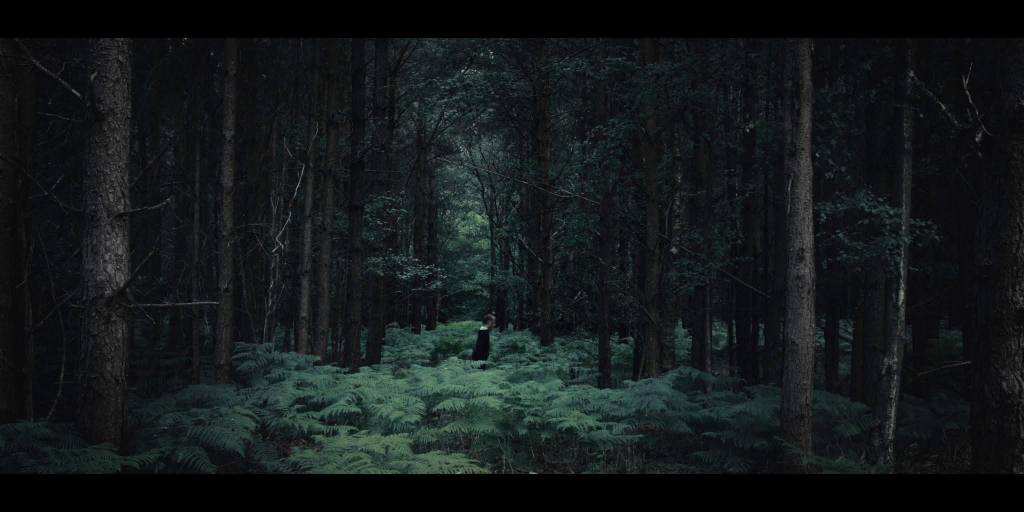
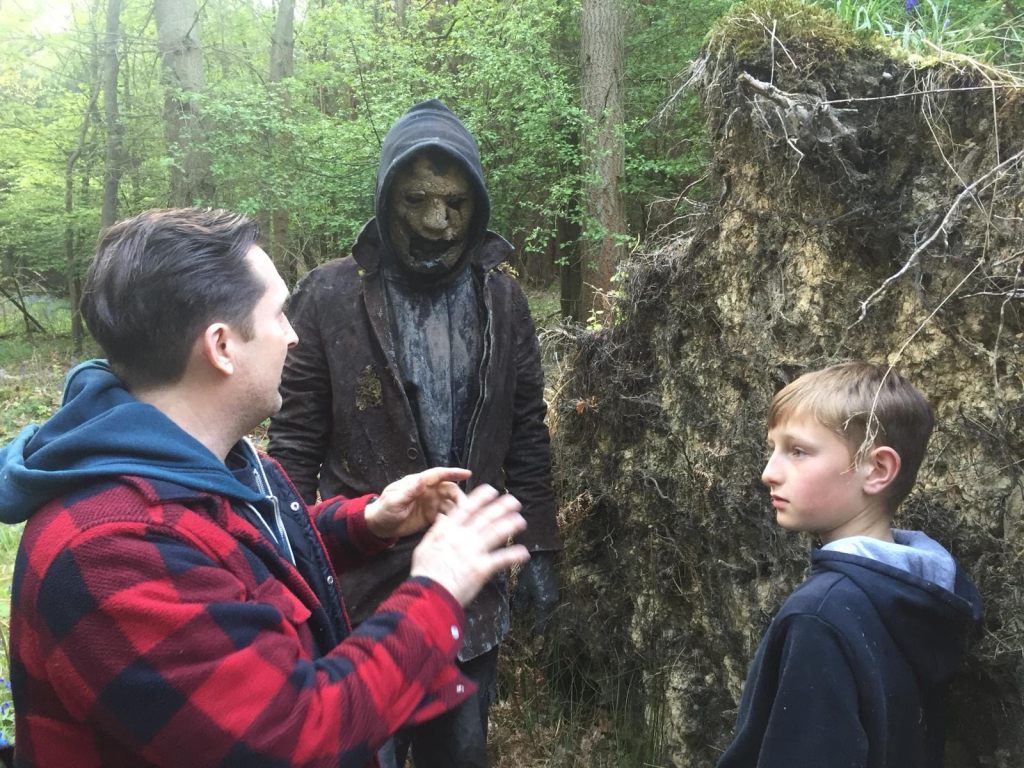
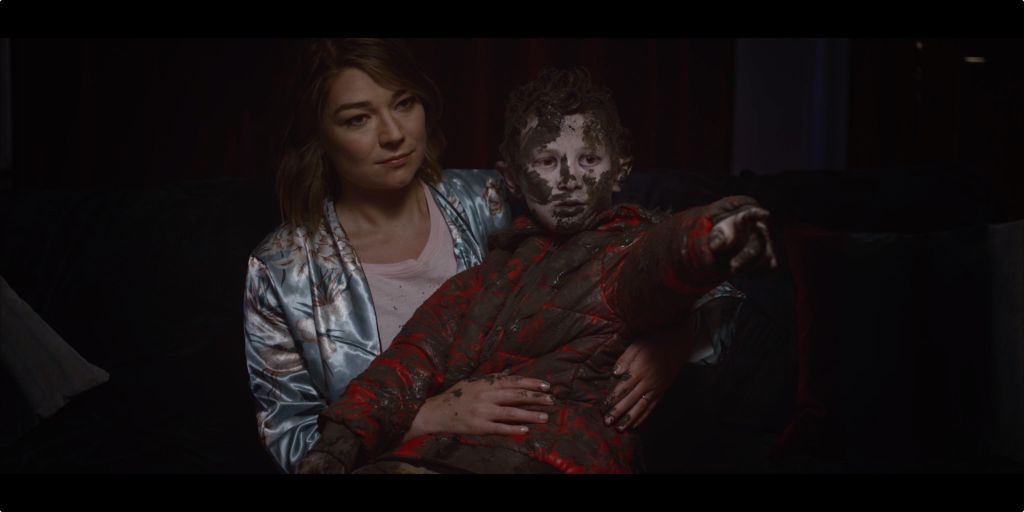
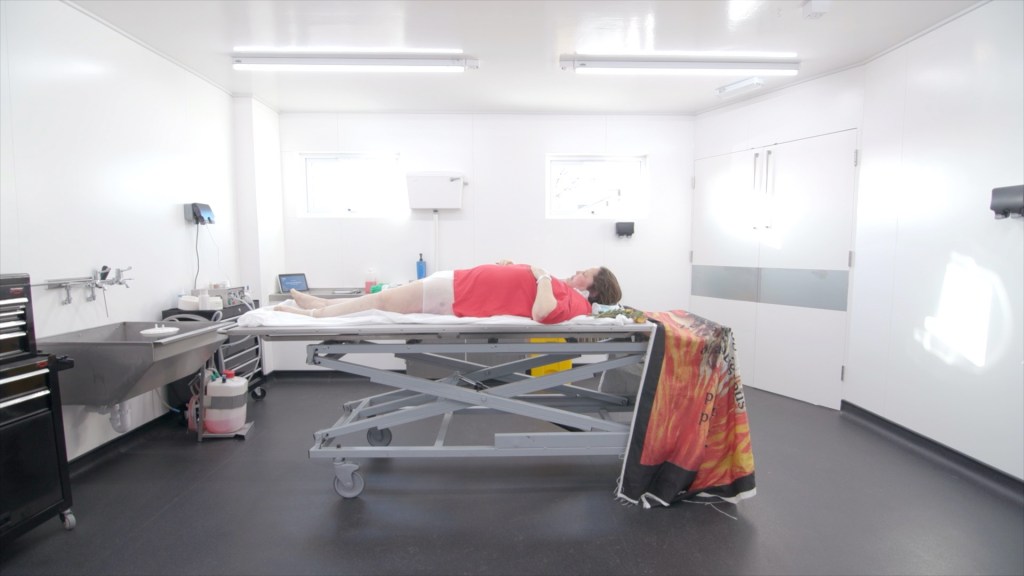
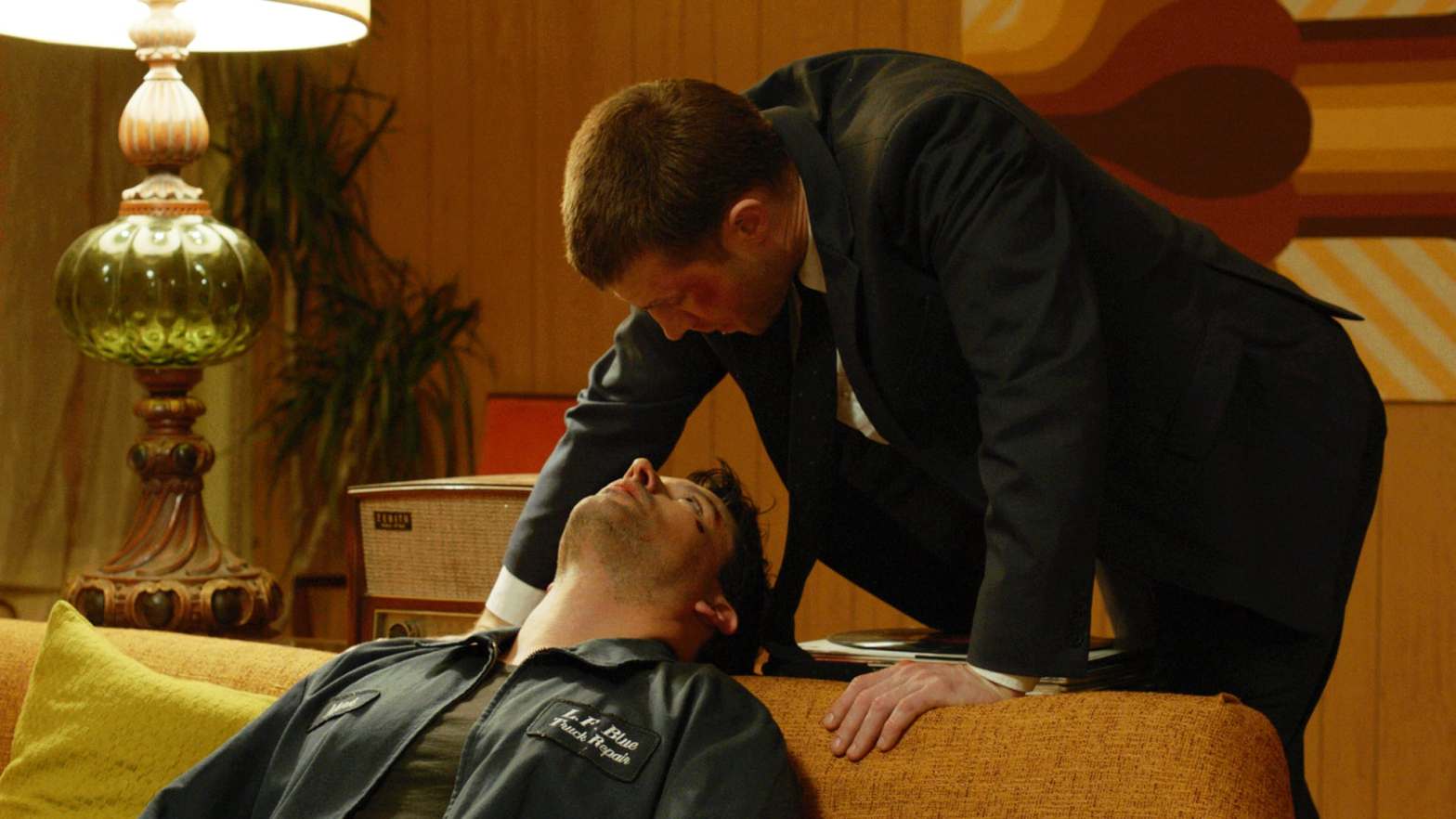
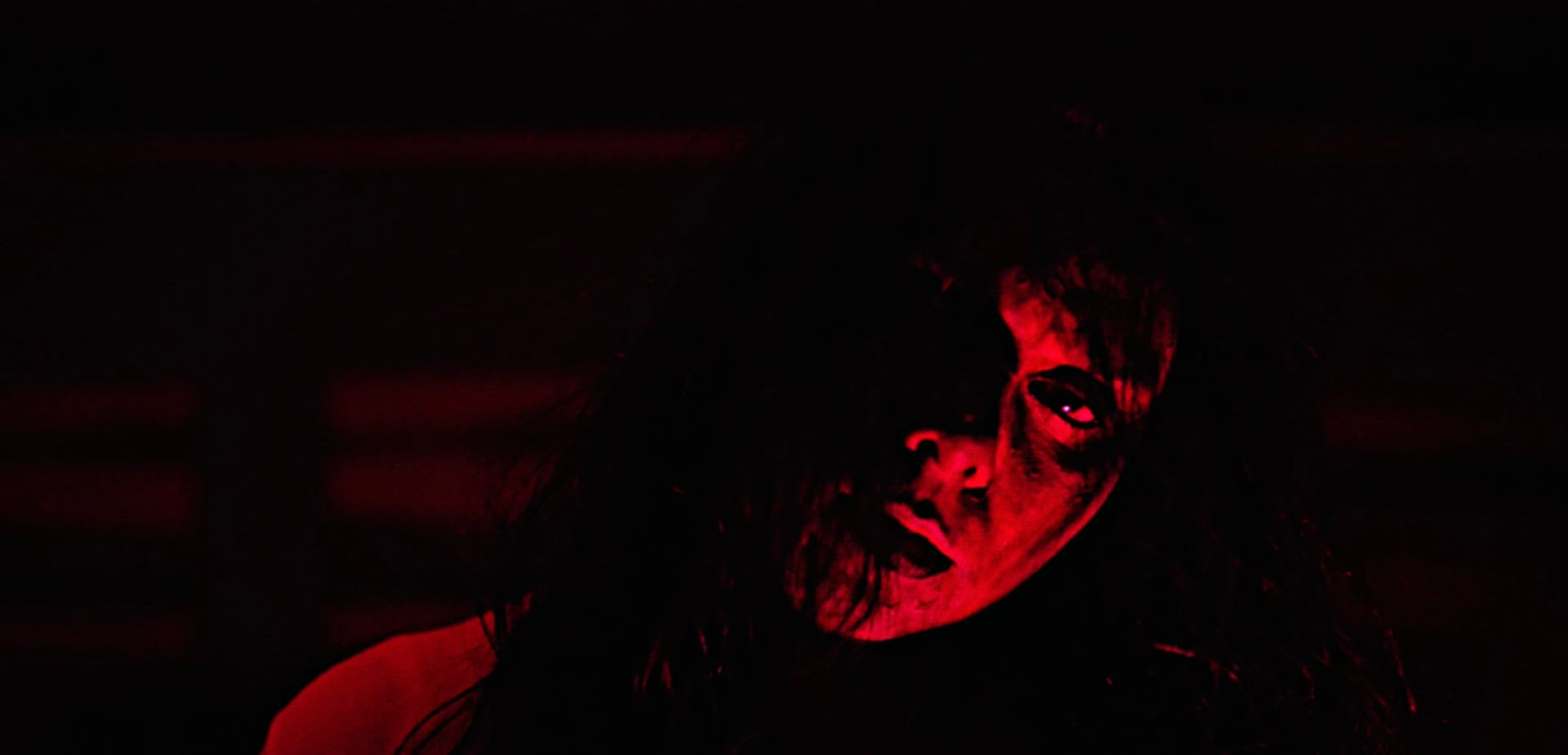
London Rocks International Film Festival is proud to be screening ‘The Mountain’ where Matthew, played by Jamie Wilkes, has to physically confront his inner demons who manifest as he is going about the seemingly mundane yet insurmountable challenge of daily life.

Mental health is something we are now starting to see broached in television, documentary and film, yet there is still a dearth in representation, especially regarding the male experience. Clare Macdonald is an award-winning film director who didn’t hesitate to take on a project which aims to break the taboo and open up a new conversation. They joined the producer Robyn Forsythe and writer Adam Steedman Thake who had been developing the script, and plowed wholeheartedly into a challengingly speedy production schedule, drawing on their experience and relationships garnered on other projects to create a rare thing: an intelligent and sensitive comedy.

“My personal preference is to explore heavy subjects through a bit of comedy as they’re really difficult. It’s so tough to project an inner life in a way which resonates, but it was such a fun project to work on. Even when Jamie’s character was having such a tough time and we doubted that it was a comedy, when you put it all together, it just worked.”

How much work did you put into the script once you came onto the project?

Adam and I worked on the script together when I came on board. It was important in particular to make sure that the film dealt with the subject matter seriously whilst remaining a comedy and also that it did not suggest that the character was cured somehow at the end. The intention of the film was to broach the topic and start a conversation about mental health struggles that are difficult to understand from the outside and also difficult for people suffering or caring for sufferers to talk about. One of the things we really focussed on together was the role of the carer which circles around the main story and the main character, bringing it back to her and the joyous impact that it has on her once he’s made this tiny bit of progress.

How did you move from finalising the script into production?

The intention of the film was central to every aspect of the filmmaking. Many of the filmmakers, cast and crew, had some personal connection to the material and felt deeply passionate about this mission. For example, the production design in the doctor’s office and waiting room is all about calling out the negativity and scariness of some of the messaging you can find yourself confronted with in these spaces, whilst also pushing to find the absurd and dark humour in that.

In terms of the performance, I wanted us to really feel the main character’s struggle, whether to answer a barrage of medical questions, well-intended though they might be, or to stay calm enough to make it home on the bus. The mental health crisis is a very physical and felt reality for this character. When it came to VFX or bringing to life inanimate objects in camera, the same intention helped ensure all the decisions were connected to our character’s physical reality in order to open his inner world to us. One excellent surprise was quite how much a large format camera really helped expand the space in our doctor’s office, which was very tiny in reality, but the camera made it into a bit of a Tardis and suddenly there was room for everything we wanted to do!

Were you ever worried about talking about mental health through comedy?

I was slightly worried that we could be seen as being tasteless as it is such a serious subject, but I think that’s why comedy is a great way to approach it because it’s a way to start a conversation that no one’s necessarily keen to bring up. My personal preference is to explore heavy subjects through a bit of comedy as they’re really difficult. It’s so tough to project an inner life in a way which resonates, but it was such a fun project to work on. Even when Jamie’s character was having such a tough time and we doubted that it was a comedy, when you put it all together, it just worked.

How did you approach the punchy funny notes within such a serious subject matter?

A lot of it was already in the script. We had such a short time frame on the film, I was given the script on the 5th of December and was asked if we could complete it by Christmas, although the subsequent Covid outbreak gave us a little extension on that. I always approach comedy as I would approach drama and, funnily enough, ‘The Mountain’ now has a nomination for Best Drama. Basically, truth and authenticity are the key to talking about anything you want to talk about. I don’t think that there should be any limits to what you can do in any genre. It’s just about whether there’s a kind of authentic intention behind it which I am always looking to draw out when I ask the writer a million questions.

Our male main character is the one who we obviously focused on in this story as gender does come into play. All of the characters that he encounters in that journey are from his very negative inner monologue, and there’s a lot of toxic masculinity in them. He’s inventing these characters himself from his environment and I asked Adam, how do you feel about that? Where does this pressure come from? Where does that pressure come from? He was really great about answering my questions and not telling me to take a hike.

Gemma Yates-Round, who plays Michelle, is brilliant and I felt a real u-turn in my empathy for her and her journey. How did you come to work with your cast?

So I had worked with Gemma on the previous film that I did called 1-800-D-DIRECT, which is about women in the 1960’s running a sex directory under the nose of their boss in a Manhattan dishwasher sales company. It was written by Gemma and Hayley Bishop, and I came on board and directed it and she was also playing one of the leads. Right from the offset I thought she’s got this amazing quality to her and an emotional depth to the performance. We saw lots of auditions for the main role of Matthew, which were all great options, but as this was a role with essentially no lines, I needed someone who could bring all the emotion to the screen without speaking, which is really challenging. It is also a short film and you don’t get a lot of rehearsal time. I had worked with Jamie before and seen him on stage, and he really can do pretty much anything, so I knew he was the right choice and he handled it beautifully.

What’s your particular style when working with and directing your actors?

It’s different every time depending on the piece. In 1-800-D-DIRECT most of the cast had been to college together so that project started with a table read to feel it out and then we put it on its feet and we had a bit more rehearsal time, which was absolutely necessary because we shot that one in a day, but they already had that connection together. For ‘The Mountain’, Jamie and I spent quite a long time actually talking about the character, about mental health and about the kind of feelings that create that inner monologue and how to connect into that. This all meant that on the day of the shooting he just came in and was in character. It’s always about trying to find a way to connect with each actor and the character and allowing them to bring that to life efficiently.

I love the VFX and think those elements add so much to the overall tone. How did you approach these?

Steve Bray was my VFX supervisor who I worked with for the first time on 1-800-D-DIRECT. I sent him a script before the shoot and he came back with the most amazing report which helped me plan. He came onto the shoot as I was doing things I had never done before, such as a snow storm in the flat, and as we didn’t have time for a screen test, it had to work! The initial script actually had a puppet scene instead of a live action sequence, which was impossible financially and timewise, so we had to decide on what we could do. I had a long chat with the amazing animator Chris Brake and we spent two hours talking about puppets. He makes these really emotional puppet films from the environment and I noticed that in his films if there is somebody eating eggs, the puppet will incorporate egg shells. The connection is really, therefore, authentic. So that’s how I approached our situation with a much lower budget and shorter timeframe. Steve was key to that because he was on set and he could look at it with his technical expertise. I had a list of shots that would need VFX and my goal was to deliver that list. l didn’t want to suddenly have 65 more shots and Steve was really brilliant because he would say exactly what we could and couldn’t fix later in real time.

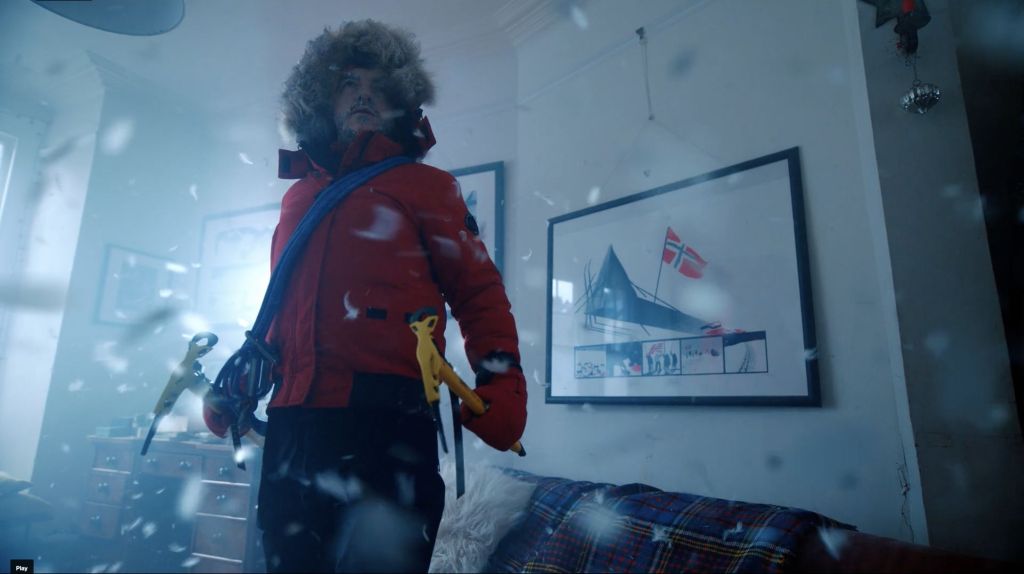
The snowstorm is made of feathers because our character is lying in his front room on a couch with a cushion under his head at the time. The reality / imagined worlds are blurring and I wanted to pull that all the way through the scene. We were working with the art director who created the snow from a feather pillow and a fan. We worked hard to get the movement of snow right, as it doesn’t just fall – it flutters and floats and we worked on a few iterations to get the movement right and build out the storm in post.

What do you hope for your film?

The intention of the film was to start a conversation about mental health, and so far we are seeing that really happen at screenings, which is great. We have begun a festival run with BAFTA- and BIFA-qualifying festivals in the UK, and some exciting nominations including Best Director, Best Narrative Short, Best Post-Production and, the latest, Best Drama in the UK and the US. That is a pretty exciting outcome for a three day shoot less than a year ago!

‘The Mountain’ will be screening on Friday the 4th of November, during our 3rd Session, as part of the Experimental Film & Comedy – “Further down the rabbit hole …”

Interview with Daniel Thomas Freeman, Writer, Director and Producer of ‘The Day After’

Daniel Thomas Freeman’s feature film, ‘The Silence After Life’, won the award for Best Actress at Brighton Rocks 2020 and we are delighted to be hosting him again at London Rocks this year with his latest film ‘The Day After’. Daniel has a multifarious background immersed in and around music and film which allows him to experiment with both forms and has led to the creation of the visceral and haunting work ‘The Day After’. An experimental short which demands to be watched and then rewatched in order to absorb the full impact. This film is the first in his NULL Audience series which will house work which is deliberately created with the expectation that only very few people will ever experience it. After the release of ‘The Silence After’, Daniel asked himself why should any one piece of artwork demand more attention than any other? Why spend so much time promoting art when the focus should be on the work itself? 

‘The Day After’ is a beautifully-crafted project from which the audience can decipher a multitude of explanations and feelings if they allow themselves to open up to the craft and really immerse themselves in the work. Daniel was inspired to create the film after Russia’s invasion of the Ukraine and pieces of work such as this are of the utmost importance lest we forget the atrocities which continue to blight us all over the world, including in Ukraine. We spoke about the intricate weaving together of the film and the sound he deftly created and went into more detail about his motivation to create the NULL audience series and what exactly it entails.

“The artwork is just one person’s individual attempt to prayerfully and quietly lament the brutally unleashed tragedy and insanity now laid before us.”

Where was this beautiful piece of work borne from?

’The Day After’ was much more of an emotional reaction than a concept. I had been in the middle of working on the follow-up to my last film ’The Silence After Life’ when the Ukraine invasion happened. And literally the day after the war started I woke up knowing that I had to indefinitely pause my current film project so I could create a new piece of music to mourn for Ukraine and for how the world had changed irrevocably in that instant. A week later I knew I had to add images to that music.

As ‘The Silence After Life’ was your first film as a director, writer and composer – what have you learnt and brought into the creation of ‘The Day After’?

I had so many good experiences and I learnt so much through the five years of making and releasing ’The Silence After Life’, but making that feature film nearly killed off my enthusiasm for film for good! You can definitely make a narrative feature with very few crew and with a budget of a few thousand pounds, but I would not necessarily recommend it as it involves a truly enormous amount of work.

Once I’d spent a year recovering from ‘Silence’ I decided that, if I was going to make another film, I would have to do it in a much freer, quicker and impressionistic way – much more about instinct and feeling and exploration than scripting and planning and admin. For many years I’ve been creating music by recording, processing, re-recording, reversing, layering, looping, stretching, compressing and distorting audio and, for the first time with film, I applied the same sorts of techniques to images. I did think about adding actors or narrative or poetry but, in this instance, I felt the project needed to be much more abstract and visceral, open and unknown, lamenting and minimal.

What particular images did you look for to form this project?

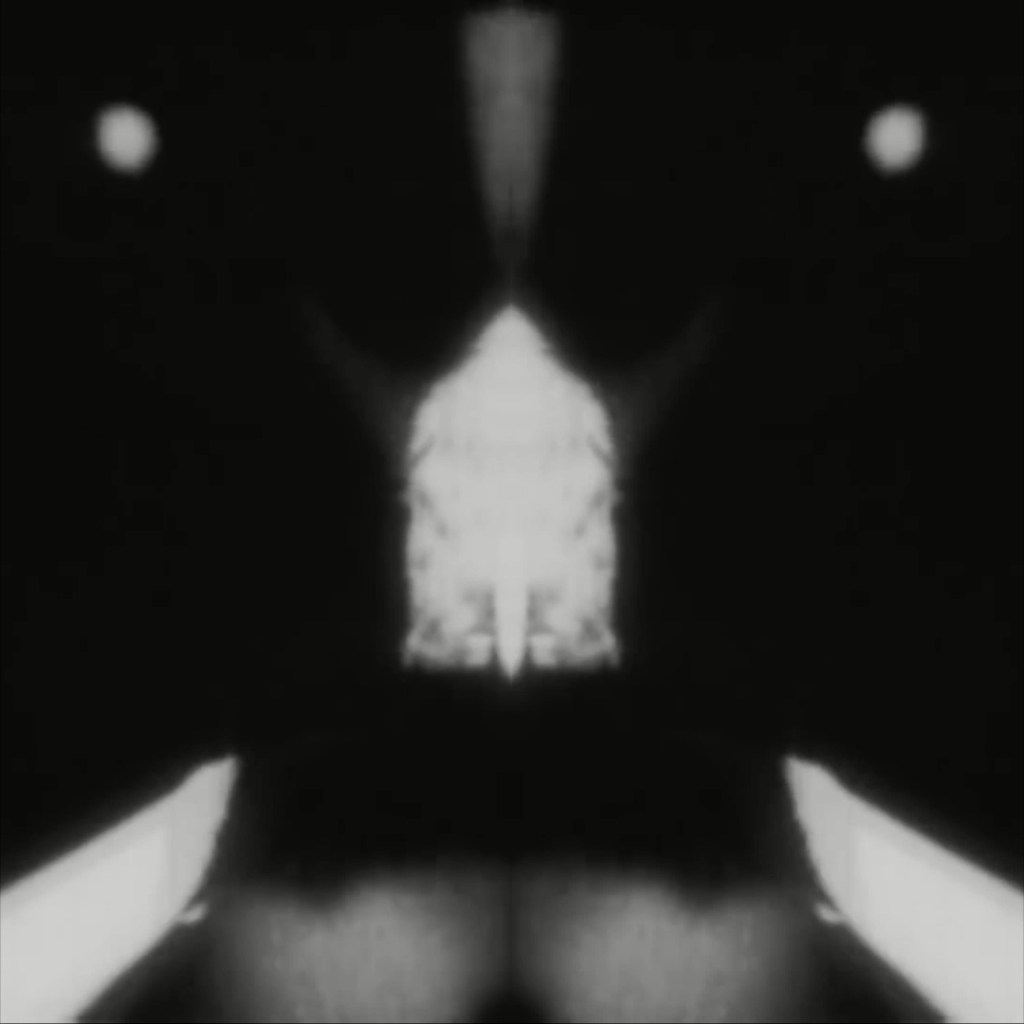
As ’The Day After’ was my immediate, emotional reaction to Russia’s invasion of Ukraine, I was looking for a way to transmute the terrible images we were seeing from Ukraine into something elegiac, a form of “turning swords into ploughshares”. As it stands now finished, the wordless images suggest x-ray ghosts of endless apartment blocks and the constant, unyielding dissolution of certainty against a dense, slow-motion fog of controlled feedback and drone choirs.

Can you go into more detail on how you layer the images in your analogue and digital processes to create the scenes we see?

The images were created by heavily manipulating loops of existing footage several times through various analogue and digital processes, including the use of an HD DSLR, before being finished in Final Cut Pro. The music was initially performed on analogue and digital electronics with some noises from an electric violin, before being heavily re-worked and processed. I used very standard analogue and digital tools but I used them in combination to create not-so-standard processes which – for this film – I purposefully made very analogous to the processes I’ve used for the music I’ve been involved in writing and producing over the last twenty years. One example of this is that I use lots of echo in the music I make, so with one of the visual loops in the film, I created visual echoes by duplicating the loop several times and ghosting the duplicates as delays after the original. 

The overall effect is both very moving and with an ethereal soothing quality. How do you work on pacing the film with the music?

With a lot of patience. Although shooting the initial visual footage and recording the original music performances was fairly quick, finding the exact pacing and layering took week after week of careful watching, listening and reflection. Typically I found the material ran too fast for the spiritual feel I was after so it was a case of slowing the material down yet further and further and letting it breathe. ’The Day After’ is a prayer and I don’t think you can get to that meditative space without pulling back from the relentless pace of the world and allowing our souls room and time to heal and reflect.

As it is such a unique and technical project, how did you approach the edit?

I believe editing is absolutely critical to any artwork and that’s why the minimal credits for the film state “image + score + edit” and nothing else. I think it’s relatively easy to make some sort of image or sound, but what makes it work as a piece of art, what gives it context and meaning, is the thousand and one decisions made both during filming / performance and the more formal editing process. Formal editing on ’The Day After’ involved choosing which sections of footage and audio to process, which of that processed material was then re-processed, and then deciding how to order and layer the final selection of the very best of the resulting components.

To talk about the NULL Audience Series, what inspired you to start such an endeavour?

Some of the inspiration came though making my previous film ’The Silence After Life’. I made the film with the hope of getting a few thousand people to see it and the very long-shot hope of getting the film into a big or medium-sized film festival. An approach which has worked in the past for a very small number of similar outsider directors like Peter Strickland and Shane Carruth. After the standard run of too many rejections, I was really glad and grateful to get the film into three smaller festivals, including Brighton Rocks where it won Best Actress. This helped me realise that I’d personally approached filmmaking from completely the wrong angle. In retrospect, what was really important to me was making the film, the quality of the interactions of the people I worked with, the resulting film and the quality – not the quantity – of the response … which is where smaller film festivals like London Rocks and Brighton Rocks are so important and vital to independent film culture.

This was not a conclusion I came to easily. After all, I had submitted the film into quite a number of big and medium festivals, I had created a large number of social posts in order to promote the film and had paid for advertising on film and music websites / magazines, all in the hope of attracting a larger audience. But by the end, this all felt very unhealthy to me. It was capitalism not creativity, a justification of numbers rather than the deep spiritual satisfaction that flows from making good art. 

My personal conclusion was to start the NULL Audience Series. I’m planning that this will only consist of work which is deliberately created with the expectation that only very few people will ever experience it. It could be that a NULL work goes on to have a reasonably-sized audience (which could be really interesting) … but the work is not made with a target audience or marketing strategy in mind and there will be no desperate striving to bring attention to it. It’s important to me to show high-quality work – art is, after all, a form of communication – but ideally I want to enjoy that process rather than worrying too much about numbers or visibility or networking.

What is next from you and in the series?

To keep me focused on what I hope is a more practical and positive way forward with my art, I’m intending that all my works for the foreseeable future will adhere to the NULL Audience Series principles. I’ve created a ramshackle collection of words, images, ideas, music and sound for a number of potential projects, two of which are showing more promise. One is a science-fiction experimental drama set in Scotland which I’ve been struggling with for a few years now. The other project – which is a bit newer and feels much more possible to make at the moment – is a reflection on where we are with the environment. There is still a long way to go with both of these projects, especially if I’m to find a way of involving the main actors from ‘Silence’ as I’d love to do, but the experience of making and showing ’The Day After’ is proving invaluable in demonstrating a potentially more artistically sustainable approach of creating films and music. I’m hoping to get another film or two out within the next couple of years if all goes well, but that’s as near as I want to get to any sort of timetable at the moment.

‘The Day After’ will be screening on Friday the 4th of November, during our 3rd Session, as part of the Experimental Film & Comedy – “Further down the rabbit hole …”

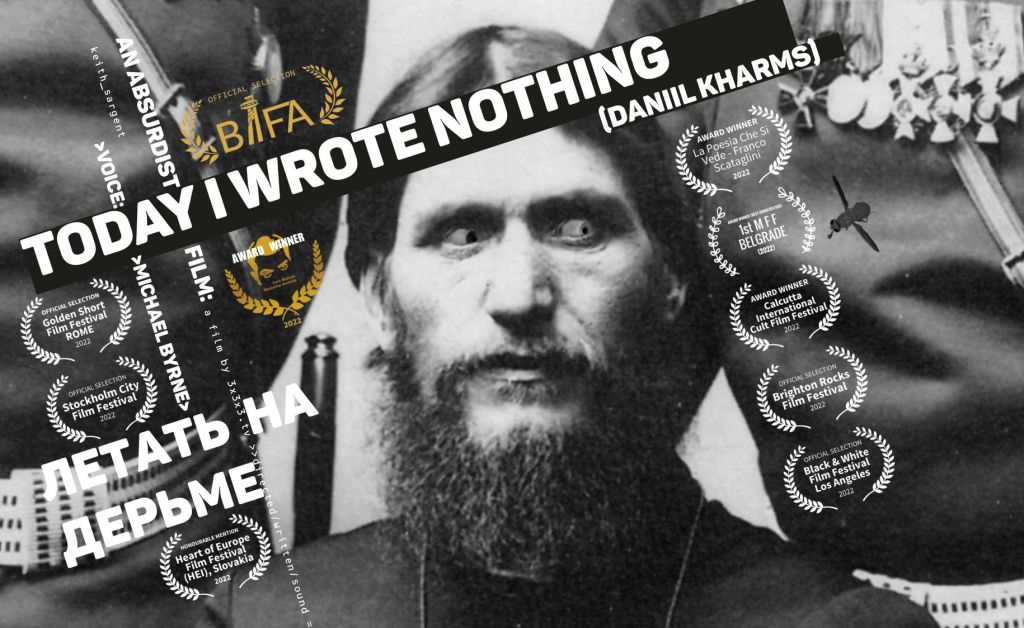
Interview with Keith Sargent, Writer, Director & Producer of ‘Today I Wrote Nothing’

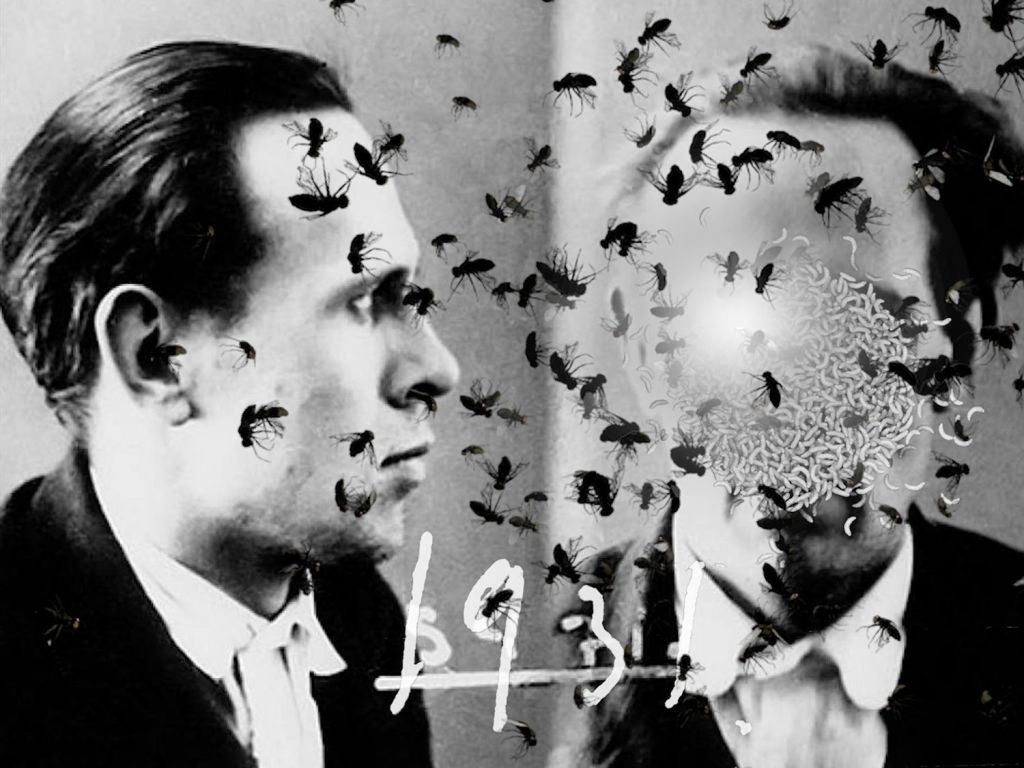
Brighton Rocks International Film Festival is proud to be showcasing ‘Today I Wrote Nothing’ by Keith Sargent, aptly named after the work of the absurdist avant-garde Russian poet, Danill Kharms. By employing his incredible aptitudes in animation, music composition amongst so much more, Sargent has weaved together a beautiful 3-minute experiential film proving that the conception of anything creative can arise out of nowhere. Filmmaker, graphic designer and educator Keith Sargent Sargent was gracious enough to take the time to explain some of the finer components of the film and give us a real glimpse into the mind behind the madness.

‘Today I wrote nothing’ is a mere taste of things to come from Sargent, who has wholeheartedly embraced the backbone of Kharms’ writing and his ability to pause, stop, give up, not be arsed and be playful. The longer piece ‘Fly on Shit’ is awaited with eager anticipation.

You can do things and you can let things happen and make mistakes, which is similar to filmmaking. You have to throw absolutely everything at it so you have a timeline full of shit!

Can you start by telling me a little bit about your film?

It was really something done quickly as part of a larger project which I have been working on for about a year which has 10 different micro-fictions by Daniil Kharms. I was trying to get money to make the extended version and I thought I’ll try Kickstarter. For the campaign I needed to put together a short version or a promo so I used all the stuff I’ve been working on to create ‘Today I Wrote Nothing’. I did it in about two days and ended up really liking it, so I started putting it into film festivals and within a month I had won 4 awards over different festivals. 

What was the overall inspiration behind the film?

I was making a documentary a few years ago in China about steelmaking and that got me into talking to people who were part of that cultural revolution and the big changes through Mao. From 1916 to 1920s and the 1930s, I found you’ve got this really strange time where so many things were going on and there were all these sort of clashes and changes and of course, everything’s 100 years later now.

It is a weird connection but it brought me to Daniil Kharms’ stories. They are absolutely beautiful because they can go nowhere and they can go somewhere or they are just left open ended. Quite a lot of his writing ends with, and that’s what it is. So unpicking that makes me go over the writing and it becomes very easy to put his stories into another context, because they are so open-ended and they have a beautiful translation to them. 

What about Kharm’s writing spoke to you?

He died when he was a mere 36 or 37 and spent 10 years in an asylum in a botched effort to avoid the gulags. He had lots of bizarre affectations such as changing his name, wanting to look like Sherlock with a deerstalker hat and pipe, and he would imitate people walking down the street as well as embracing the absurdity of the situation at the time. He was known for writing children’s books, but apart from that not a lot of his writing was published and it is still hard to find. He would have ideas and 10 pages of notes about that idea. The structure of his writing is very sparse and sometimes ill-conceived, but I love the way it was written. The idea that something doesn’t have to follow convention or complete with a bang – you get it or you don’t get it. I love the mystery and you don’t really know what he is driving at or why and there is no sense of an ending. You can do things and you can let things happen and make mistakes, which is similar to filmmaking. You have to throw absolutely everything at it so you have a timeline full of shit!

So how do you then take these writings and then put them into a film? 

They start off with a flavour. I have a lot of footage taken during lockdown. I live in a dockyard and take my dog for a walk in what we refer to as the wasteland, which is a place that nobody else really goes to with a Tarkovsky feel to it; polluted with scorched earth. There’s lots of wildlife all amongst abandoned ships, boats and rusting hulks – it has a very “end of the world” feel to it. I started by filming myself in that situation in winter with the dog, and I became this sort of Russian sailor (which allowed for the long grey coat) and then I started to take apart his stories and tried to imagine who the characters would be and the linear structure of one character walking through places. If you haven’t got access to loads of money, actors and performers then you have to make them up, which is why so much is animated. It becomes an easier route, but also filled with problems as it’s quite time-consuming – but at least you’ve got control over the actor.

Can you go into more detail on the style of animation in the film?

I went to St. Petersburg a few years ago and took photos, but they weren’t really good enough to use so I had to try and evoke the feeling of the city – the regency, the buildings and the Eastern European feel. The only way I could really recreate that was through the 3D software, but it all started with the photographs. I wanted it to be black and white because because I felt it was a great way of unifying all the disparate footage and other elements together. From a practical sense, I could also play with the light and dark and control what is being shown. To use a specific example, the man in a tree with a brain is from Kharm’s writing – he looks up into a tree and sees a man waving, then takes his glasses off to clean them, and without them he can’t see the man. When he puts them back on, however, he sees the guy in the tree shaking a fist at him. I was able to embrace the madness of creating this character.

The voiceover is a perfect choice for the piece. How did you come to work with the accomplished Michael Byrne?

I initially used my own voice but didn’t like the sound of it. As well as being a well-known and great actor, Michael happens to be my neighbour so fortunately for me, we agreed the payment would be made with wine. He isn’t very good at reading out loud as he normally learns his lines, but we found a quiet spot in the basement of his house and started work. I kept on asking him to go through the piece and he was tripping over the Russian names and eventually he started to get quite pissed off with me and the sound worked so well. He started reading faster and faster and you could sense the tension and the annoyance so I pushed him, tried some distraction techniques and started feeding him some lines and it came out wonderfully. He has a beautiful voice and was perfect for this and since my festival run, he is only asking for a small percentage of the glut!

Alongside the direction and everything else, you composed all of the music. How did you put the soundtrack together?

I started by listening to lots of red army music, male choirs, a lot of music from Dr Zhivago on top of some Russian Slavic music, and then it was a case of putting it all together. There are 10 different parts to the full-length film, so there is a lot more but I think ‘Today I Wrote Nothing’ is the most laid-back. It was a lot of fun trying to make it all fit – folk music, Russian armies marching down the street and some sort of religious laments. It all goes back to Tesla – he was able to visualise the entire scope of his inventions, how the machine would work, how the electricity would flow, but the biggest challenge for him was actually putting pen to paper, so he missed out on a lot of patents. Whilst having these visions he would hear music with influences from Turkey, the Middle East while taking in so many more flavours of that time. I tried to do the same with the Russian music and get myself into a transient state to feel it.

What are your hopes for the film? 

For it to be seen, for folks to want to see the longer version, and to introduce the world to Daniil Kharms.

‘Today I Wrote Nothing’ screens at 7.15pm at Fabrica on Saturday the 23rd of July as part of BRIFF’s 15th screening programme. 

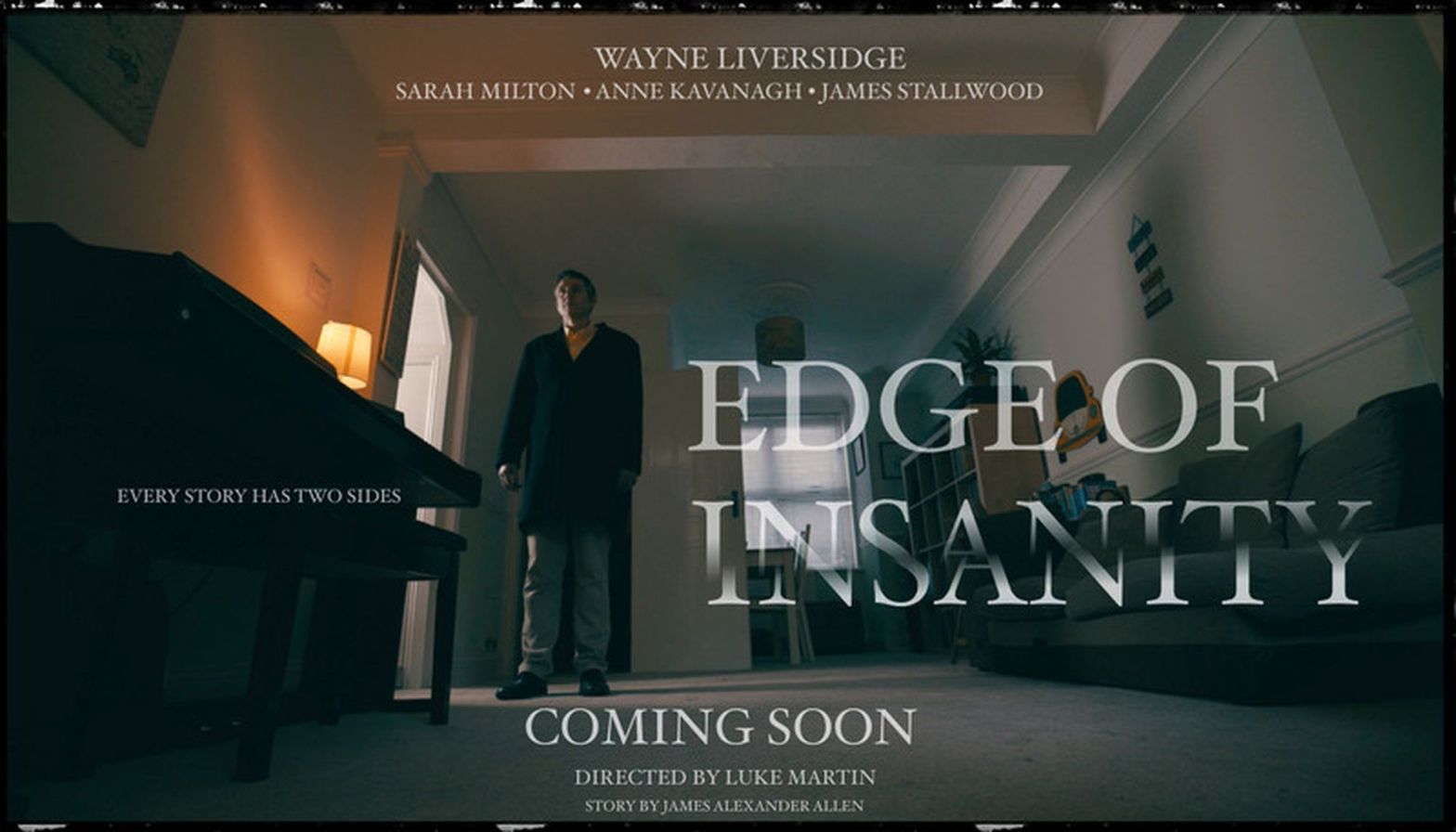
Interview with Luke Martin and James Alexander Allen of ‘Edge of Insanity’

Crime fascinates and repels us all at the same time, and detective stories draw us into their dark and complex webs and the characters hidden within. When the chance arose to develop a sequel to a 2016 short ‘The Private Investigator’ by BRIFF alum Alex Lines, writer James Alexander Allen and director Luke Martin joined forces along with the original actor Wayne Liversidge. Using the dark and gritty streets of Brighton as their backdrop, the drama tells the story of a mute private investigator obsessed with murders who is recruited by the police. We are always thrilled to feature films made in Brighton, especially those that leave you wanting more, and ‘Edge of Insanity’ has you questioning every piece of the puzzle whilst keeping a formidable pace and momentum throughout.

How did you come to be working together on this film?

James Allen: After writing the first draft of the script in 2018, and getting Alex Lines’ blessing on it, I began collaborating with Luke as the director. We had so many ideas that the script practically doubled in length, so we had to work hard to trim it back. But this process brought out some beautiful gems, especially from Anne Kavanagh’s character Norma. 
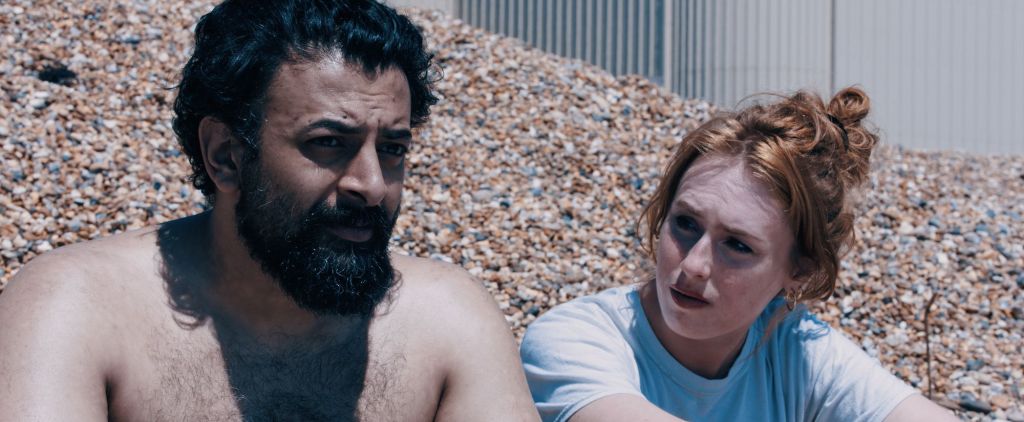
Luke Martin: I had seen the first film, ‘The Private Investigator’ and was extremely impressed with the economical way it was put together. It was evident that it was made with very little budget, only starring Wayne and shot in one location. I’m always impressed when a clever and interesting story can be told with next to no resources. I was approached to get involved with the sequel and I liked a lot of what it contained and felt it had potential, so I agreed to direct the project. I felt there was a great opportunity to expand upon Trevor’s character, and offer a little bit of backstory. One of the things that I liked about ‘The Private Investigator’ was Trevor’s condition. He suffers from aphonia, so he’s mute, and I thought it could be interesting if we could explore that a bit further. After researching into aphonia and discovering that it could potentially be caused by trauma, I saw the opportunity to be creative and carry on telling his story. Has Trevor always had this condition, and if not, what caused it, and when? 

Wayne Liversidge – “Trevor Murphy”

How much did you take from the original script by Alex Lines and how did you find the task of writing a sequel?

James: I remember going through the original film and looking at each location presented and making sure the real life street names were mentioned in dialogue. We’ve been through a couple of revisions over the years but I recall at one point you could almost have blended the two together into one movie! It was my first time developing a script for a movie I knew would be directed by someone else, so that was quite a buzz from a career standpoint.

Can you go into more detail about the development of the script and what you specifically wanted to include?

James: The original version was a lot more sprawling with several subplots. The element that I started with in the very beginning and that I was anxious to maintain was the idea of Trevor and the Cinderella Killer being “two sides of the same coin,” as Sarah Milton’s character describes them. The biggest development when Luke came on board was that the character of Norma the landlady (played by Anne Kavanagh) become far more prominent in the story than the walk-on part she had originally.

Luke: The initial script by James had a bigger focus on a copycat killer, which was an intriguing idea but I felt it took too much centre stage and demanded a more challenging setup.  Personally, I was more interested in the character of Trevor and what drives him. I sat with James and discussed that, and we began working on trimming certain elements and replacing them with more practical, but also more intriguing, elements that tie in with backstory.

Anne Kavanagh – “Norma”

How did you then move from the ideas stage and script into the more practical elements?

Luke: It was always agreed, very early on with the cast and crew, that this production would take a little while. We initially had no budget and agreed that the shoot would take place over various weekends, when everyone was available. This project was always going to be more challenging, as the script demanded we had more characters, more locations etc., compared to ‘Private Investigator’. We initially started shooting a few scenes just with Wayne, and once we had those under our belt, we planned some of the bigger scenes. At that point, we had accumulated a bit of budget, and I started casting for the roles of Claire and Norma.

We shot the film over the course of 4-6 months, post-production, as always, took quite a bit of time and whilst all of the shots were fine, I had quite a bit of work to do to clean up dialogue and add sound effects. Overall the film took around 3 years to fully finish. That is obviously quite a long time to make a short film, but due to schedules, a small budget and my final year in Film School, it took a bit longer. 

Sarah Milton – “Claire Stanwick”

What is your MO in postproduction to attain your final product?

Luke: I begin editing the ending, it sounds odd, but if I can get the ending just right, then the rest falls into place a little. For me, the ending is the most important part of a story, so it has to be strong. Editing is all about rhythm and emotion, and I feel that if I can finetune the ending and make it work, then I can just start working backwards from that point. After that, everything goes out of the window – I watch the film 60 plus times, pull my hair out, and wonder why I got involved in the project in the first place!

There seems to be a fabulously collaborative work ethic between all of you – how do you achieve this and how do you think it helped the film?

James: Wayne and I have worked together a few times since 2016 on numerous short projects and one stage play. I met Luke through this project, and found that the more I got to know him personally, the faster and more efficiently we worked together. I recall we’d take the better part of a day to break a draft at the start of the process, and by the end we were writing fresh drafts in about 15 minutes. It goes to show that this industry is all about relationships.

Luke: I think, first and foremost, we are all friends. That helps massively. Additionally, everyone in the crew has their own passion, whether it be James and his writing or Adam with his music/sound production. So, we already had a bit of a rag tag crew that were willing to spend time in their own field. We didn’t really have to source for additional crew (apart from Jakub, who came on board as DoP). The fact that we are all friends made the shoot as stress free as possible. In the end, we were just having a bit of fun. Some of my favourite films growing up, I’ve looked at them and thought, I bet they had fun making that. I think that can resonate into the film. Also, we had hardly any money.  From my point of view, that takes a bit of pressure off, as whatever you produce, you will be proud that you did it on a less than shoe-string budget. Plus, I think it makes you get more creative, when you know you have financial restrictions.

What do you hope for the film?

Luke: In simple terms, that people watching it find it an interesting story and a good follow up from the first film. It sounds cheesy, but I actually just wanted to do justice and make a film that at the very least, equals the first film. I’ve met Alex (writer and director of ‘Private Investigator’), and he’s such a nice bloke, so I wanted him to be proud of the story we told.  He says he likes it, so hopefully we did a good job.  The way ‘Edge’ finishes, there is potential, I feel, for maybe one more film. In my mind, this is a 3-part story.  In my opinion, I know how Trevor’s story ends, and I think we have been given an opportunity to potentially tell it one more time. Whether it’s me directing or someone else, I will make sure I pass on my thoughts about a final chapter.

‘Edge of Insanity’ screens at 4.30 – 6.00 pm on Friday the 22nd of July 2022 at Rialto Theatre as part of BRIFF’s 3rd screening programme where we will also be presenting a Q&A with the filmmakers.

Interview with Darcy Vanhinsbergh & Alex Lawton of ‘Cold Water’

Who amongst us cannot claim to have whiled away the hours watching others around us going about their daily lives? Darcy Vanhinsbergh, whose background lays predominately in front of the camera, used the forced moments of contemplation driven by the pandemic to consider the people he has been observing, their intricate social dynamics and what they were doing in life, and took to writing. He is centre stage in the production of Brighton-based ‘Cold Water’ as writer, director and performer, and has masterfully crafted a balanced and nuanced portrayal of two very different people whose lives converge under mundane circumstances. When Alex Lawton, whose skills cross production, cinematography and editing, reached out to Vanhinsbergh about working together, ‘Cold Water’ started to bloom. The film addresses the real and terrifying issues of addiction and control, but rather than reveling in the darkness, it shows us that you really don’t know what – or who is around the next proverbial corner. 

“I guess it became an exploration of how imperfect we all are.” 

Where did the inspiration come from to explore two such unique characters?

Darcy: Alex had approached me about working together on a short and I was concurrently talking about ideas with my partner. We got on to the people we knew, friends and work colleagues, our strange interactions and imperfections. Some really interesting stories came up, and it kind of inspired me to base a story around an amalgamation of people I knew, including myself. I guess it became an exploration of how imperfect we all are. 

Alex: I worked with Darcy as the lead role in 2017 on a short film which I produced and directed called Winter Hill. During production I got to know Darcy and I realised that he was much more than an actor – I’ve worked with plenty of actors in the past and generally from my experience an actor will turn up, deliver their performance and go home, whereas Darcy invested himself much more into the overall story-line, script and the project as a whole. This left an impression on me and when I was looking to collaborate with a writer/director on my next short narrative project, despite him being an actor first and foremost, Darcy was the first person I reached out to.

Why did you feel the need to cut down the script and how long did it take you until you felt comfortable enough with it to start filming?

Darcy: As a film writer I’m constantly trying to work on showing rather than telling. I think when you overuse dialogue it becomes indulgent and you can very easily fall into traps. I’m happy with it, but I still feel it’s over-written. I’d like to get a lot more visually creative on our next project. It took at least 4 months before I felt we were getting somewhere. 

Vikash Bhai – “Rajesh”

When did Alex get involved in the writing of the script and how did the creative relationship work between the two of you?

Alex: Whenever Darcy finished working on the latest version of the script he would send it over for me to take a look. From my perspective, as the DOP and camera operator, I was just as focused on how we were going to shoot the scenes vs the overall storyline, so it definitely helped having both of us constantly discussing each re-write and being able to bounce ideas off each other. I remember early on one of the challenges we faced was how we were going to shoot the scenes which involved the actors actually being in the sea. We toyed with a couple of ideas; underwater cameras, hiring a boat, but neither were really an option considering budget restrictions and also the limited time which we had at our disposal to shoot the film. In the end we both felt capturing as much as possible from the drone would be the best way forward. That’s the great thing about shooting with drones, it can get you to spots which are otherwise very tricky or even impossible to film from.

Vikash and Siobhan are engaging and credible in their roles, how did you go about the casting process?

Darcy: I did a show together with Vikash in London. I knew he wasn’t just sharp-witted and funny but had the depth of character to play Raj. It’s a complicated role and we spoke a lot on the phone about addiction and positive outlets, and he just got it. We are all addicted to something and searching for a release. It’s a very human experience. I casted Siobhan through my agent. I was looking for someone fierce yet vulnerable to play Dannie, and after I looked at her reel I was dead set on casting her. She did a self tape of one of the scenes for us and that was it. We spoke on the phone and I could tell she knew what was required. It’s a draining role, but she totally owned it and went to those uncomfortable places. 

Siobhan Bevan – “Dannie”

How did you then work with the actors on the character development to find the freedom in the text?

Darcy: Once the script was learnt and I knew they had a firm grasp of the scene, I just asked them to relax, fuck it, have fun! At that point, it’s about what the actors are experiencing, and capturing that magic moment when they experience something new. So I told them to forget it as such, it’s a framework more than a script. Of course we weren’t completely improvising and they largely stuck to the script, but they started to pepper it with interjections that I would never have thought of writing. This approach takes the anxiety out of the situation and further develops the characters on screen. 

Do you have any plans to work together in the future?

Darcy: Yes! I hope Alex wants to work with me again ha. I already have the next project bubbling away. It’s got to be funded this time though, so we have to do a lot of work to get that secured. 

Alex: My favourite aspect of the process has always been collaborating with like-minded people on the front line of independent filmmaking, and despite some of the inevitable challenges that we faced along the way, we’re both really happy with the end product all things considered. In the early days of ‘Cold Water‘ we both decided to see how things panned out, testing the waters if you like, with a view to potentially doing more in the future. So yes, I’m sure when the time is right, we’ll collaborate again.

‘Cold Water’ screens at 7.15 – 8.15pm on Sunday the 24th of July 2022 at Fabrica as part of BRIFF’s 16th screening programme.

In Review: ‘The Tree’ by Oliver Blair

“Film is like a battleground,” quips the director Samuel Fuller in Godard’s ‘Pierrot le fou’. “There’s love, hate, action, violence, death… in one word: emotion.”

We get emotion – as well as a dose of love, hate and death – in ‘The Tree’, whose two characters – siblings James (Joel Morris) and Yasmin (Hayley Thomas) do fierce battle with one another in this superb dark comedy and family drama.

‘James’ played by Joel Morris

“I’m no good at this shit!” yells a fag-brandishing, rough-shaven James at his sister, proffering a bag of oranges.

“You’re a fucking prick … This isn’t sorry. This is guilt. These are guilt oranges. And you know what, James, they’re not even oranges, they’re FUCKING SATSUMAS!”

Shout, shout, let it all out! There is an incredibly raw and cathartic quality to the slanging match between the siblings, who are furious with one another in the wake of their father’s death. James failed to turn up to the probate meeting, leaving his sister to take care of the formalities. The high-octane exchange, expertly framed in closeup, exudes raw anger. The performances are electrifying; not for one moment unbelievable.

‘Yasmin’ played by Hayley Thomas

The satsumas get squashed, the anger subsides, and the pair get to work unpacking their dad’s belongings out of a decrepit burger van. The dialogue dances around the elephant in the van as they try on their mum’s cancer wigs, joke about willy dances and reminisce about times gone by. We learn that James’ restaurant business has failed because a lady fell through the restaurant floor and needed lifting out with a crane. Yasmin was seriously ill recently and worries about her son.

As they unpack boxes of wigs, getting covered in, we are expertly led towards the film’s reveal. Despite the clues, we still share the siblings’ shock when they uncover a hidden facet of their macho father’s sexual identity, yet it is done in such a way that it doesn’t detract from the real focus of this drama: the siblings’ own journey of self-discovery.

“You said it yourself,” says Yasmin from her car. “You’ve lost touch with your roots. If you’re looking for a bigger sign to do something, it’s not coming.” Her final “love ya” is a tender moment indeed.

The film casually references two films about duos: ‘Some Like It Hot’ (the name of the burger van) and ‘In Bruges’ (mentioned in the dialogue). Both movies have a lot of heart but are essentially comedies. While certainly funny, the place and situation explored in ‘The Tree’ is far more evocative of serious drama – ‘Who’s Afraid of Virginia Woolf?’ springs to mind. It’s a rare thing for a film to deftly tread the fine line between comedy and tragedy, but ‘The Tree’ pulls it off masterfully, producing a moment of pure pathos.

Writer & Director Oliver Blair

Oliver Blair has made some further strong choices in this directorial debut. He clearly writes about what he knows, setting the film close to his hometown at the borders of Nottinghamshire at Derbyshire border. It’s the sort of place where the louder you swear at someone, the more you know they love you, and where it’s still a big deal for an older, married man to have nonbinary gender. He did well to stick to one set, putting all his eggs, so to speak, into coaxing stellar performances from the talented Joel Morris and Hayley Thomas. All you need to make a great film, to paraphrase Godard, “is a burger van and some siblings.”

‘The Tree’ screens at 12pm on the 23rd of July at Rialto Theatre as part of BRIFF 6th screening session.

In Review: ‘Hold Me, Don’t Touch Me’ by Adrian Todd Zuniga

“It is only shallow people who do not judge by appearances,” quipped Oscar Wilde. This adage is certainly borne out in writer-director Adrian Todd Zuniga’s thought-provoking and memorable film, ‘Hold Me, Don’t Touch Me.’

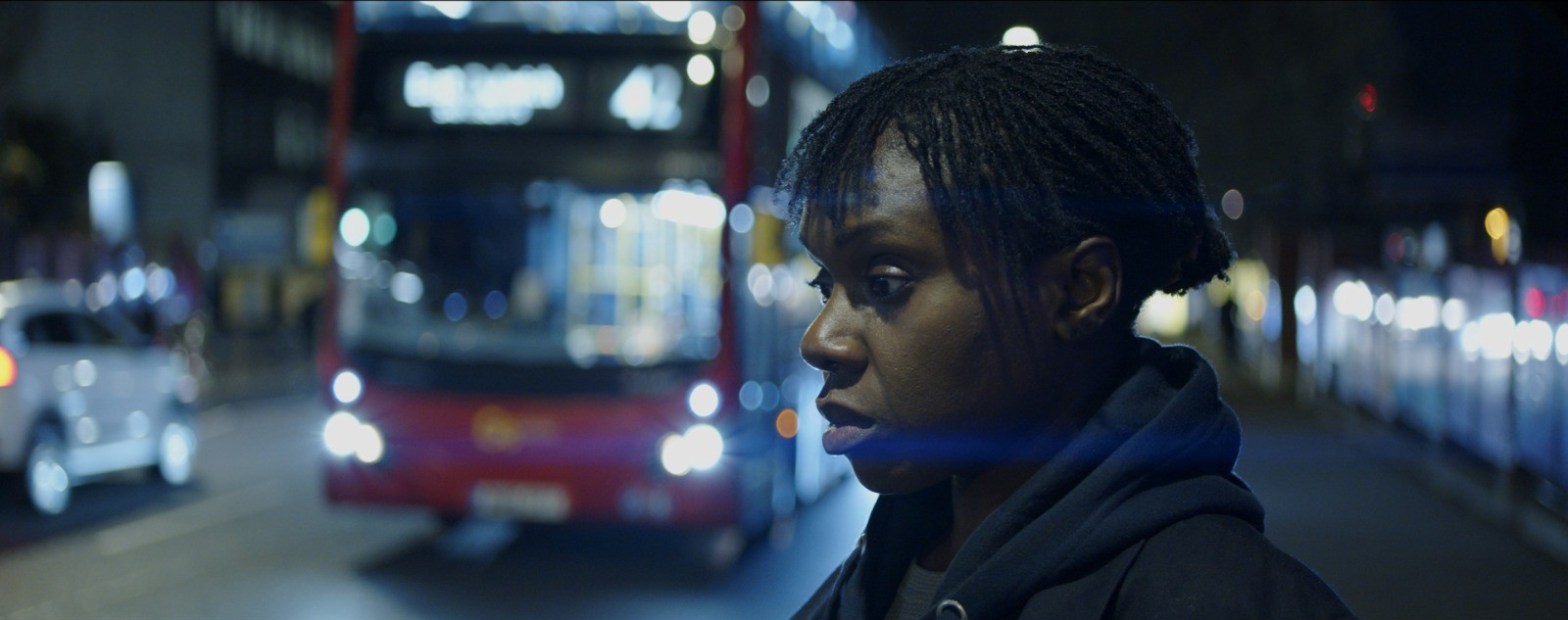
Grief-stricken Aidy, played by Anniwaa Buachie

It is a winter evening in London. Aidy, a Black British woman (Anniwaa Buachie), has not turned up to a grief counselling session and is wandering the narrow streets, lost in melancholy. She enters a pub, orders a whisky and takes a lonely seat. She ignores the bartender’s half-hearted attempt to be kind by giving her fries (“the kitchen made a mistake … going to go in the bin otherwise”). It isn’t long before Stella (Tessa Bonham Jones) rocks up to Aidy’s table. Blonde, wearing a red polka dot dress, she announces that she has come to cheer Aidy up.

“Manic pixie dream girl” Stella, played by Tessa Bonham Jones

“I’m not here,” protests Aidy – at a loss for words.

Stella prattles on about her favourite ghost movies while helping herself to the fries. Aidy tries in vain to extradite herself, but Stella insists she should stay.

“I’m all about ‘do good, be remembered fondly,’” as she whittles through a list of pop culture do-gooders.

Treating Aidy like an adoring girlfriend clinging to her every word, she typifies the “manic pixie dream girl”: vapid, self-absorbed, entitled – and in this context, unwanted. Aidy can barely look at the crass intruder. When she finally snaps, we share her outrage with conviction.

What do you get out of this? To go round hounding people? Egging them on until they fucking burst!”

Stella flinches, mumbles an apology, gets up and collapses to the floor. A leaflet marked “The Dying Process” falls out of her pocket. Aidy helps her sit down and fetches her water.
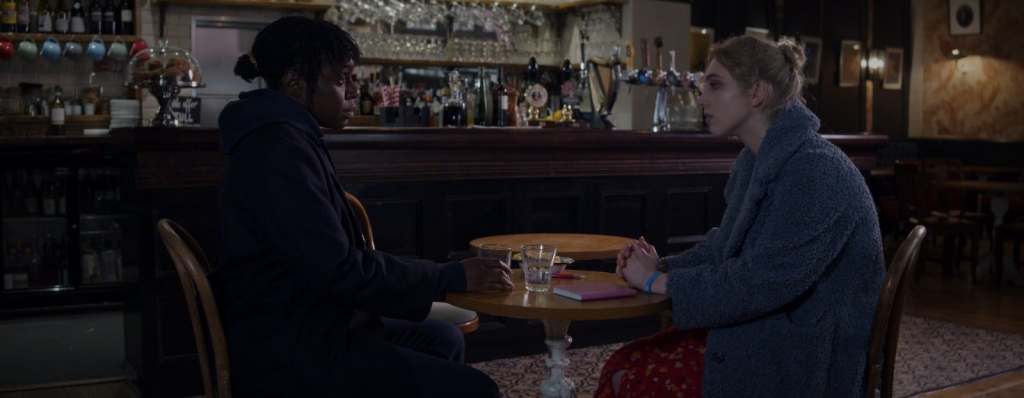
“I might have brain cancer,” is her all-too-English way of revealing that she is dying. “I’m way too vain to have all my hair fall out,” is her jokey way of saying that she only has weeks to live.
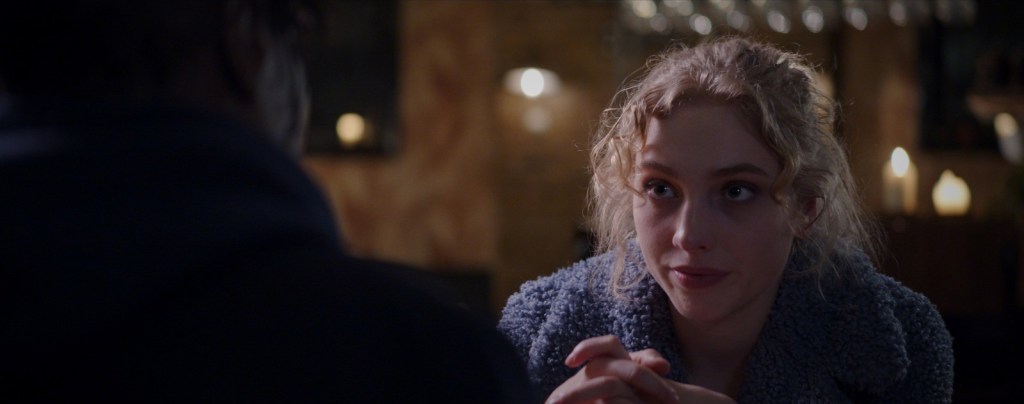
In asking her about her condition, contemplating this young woman’s “terrible” fate and trying to make her feel better, Aidy is momentarily taken out of her solipsistic grief. Other people have problems and pain too. Eager for a moment of levity, they both eat fries and agree that they are awful. The ensuing laughter belies a profound moment; Aidy has taken her first small step on her journey towards dealing with her grief. Stella has achieved her goal in helping her after all.

The camera pulls back, and a wide shot reveals the two women face-to-face, no longer isolated at the far sides of the frame as they were during the opening sequence. They are bound by a shared understanding of the fleetingly beautiful nature of life.

Adrian Todd Zuniga, who hails from America, reminds us that London is often best seen from outwards looking in. We could easily imagine this as part of an anthology about life in the city, such as Robert Altman’s tribute to Los Angeles, ‘Short Cuts’ (1993). The film also goes to show that people and situations are rarely, if ever, black and white, and that superficial stock characters can be given life in imaginative and emotive ways.

Writer & Director Adrian Todd Zuniga

One senses too that Zuniga has an in-depth understanding of “complicated grief” and the way it makes us isolate ourselves. He is also the author of a novel ‘Collision Theory’ in which the protagonist must deal with a suicide he has witnessed.

“When my mother passed away 11 years ago, it was a seismic event in my life,” he writes. “One that caused me to put up barriers as a way to hold on to the pain. Creating this film helped me pull down walls in relation to my mother’s passing.”

We feel sure this film can also help viewers pull down some of their walls.

‘Hold Me, Don’t Touch Me’ screens at 4.30 – 7.30 pm on 24th July 2022 at Rialto Theatre as part of BRIFF’s 14th screening programme.

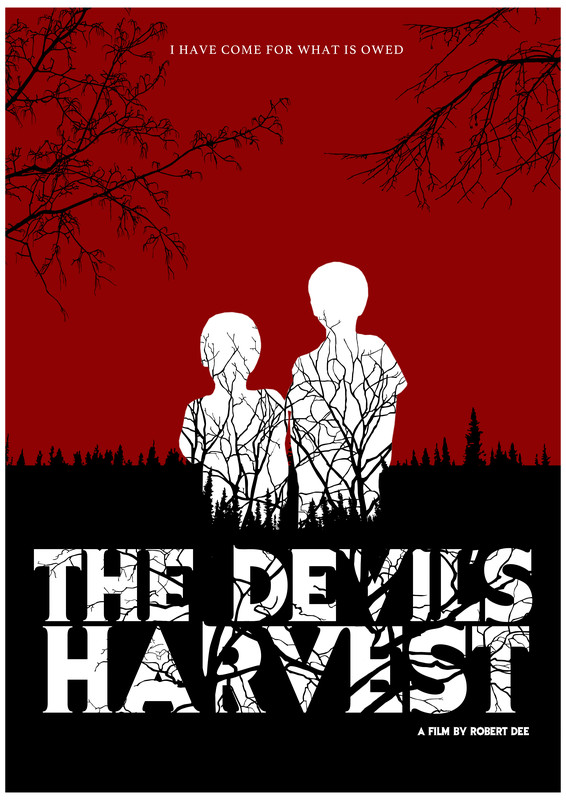
Interview with Robert Dee, Director of ‘The Devil’s Harvest’

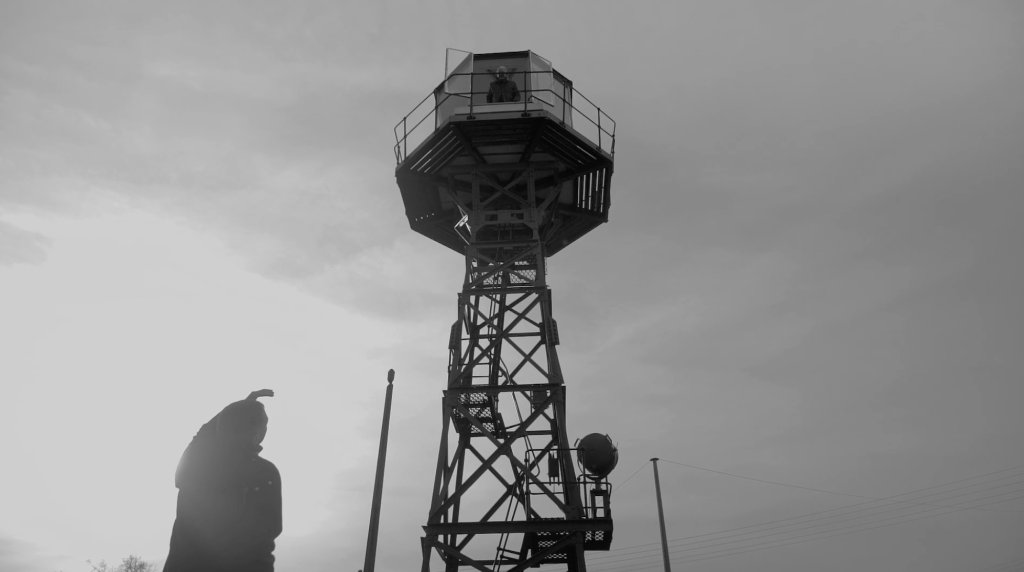
A fascination with horror is often considered macabre and perhaps slightly misaligned, but by combining his passion for the genre with a diverse career and a well-chosen MA, Robert Dee brings us his visceral short ‘The Devil’s Harvest.’ The film offers a haunted dive into identity and childhood trauma. Whilst exploring themes some might feel are better left alone, Dee delves back into his youthful discovery of the uncanny by Freud. An unsettling sense of psychological vertigo provoked by an encounter with people, places and things that are both familiar yet strange at the same time, which forms the basis of his deliciously dark folk horror. He speaks about the influences he has garnered from some of the great directors and names in movies and the sometimes conflicted application of film theory in developing the spark of an idea into the production of an intense 11 minute short film.
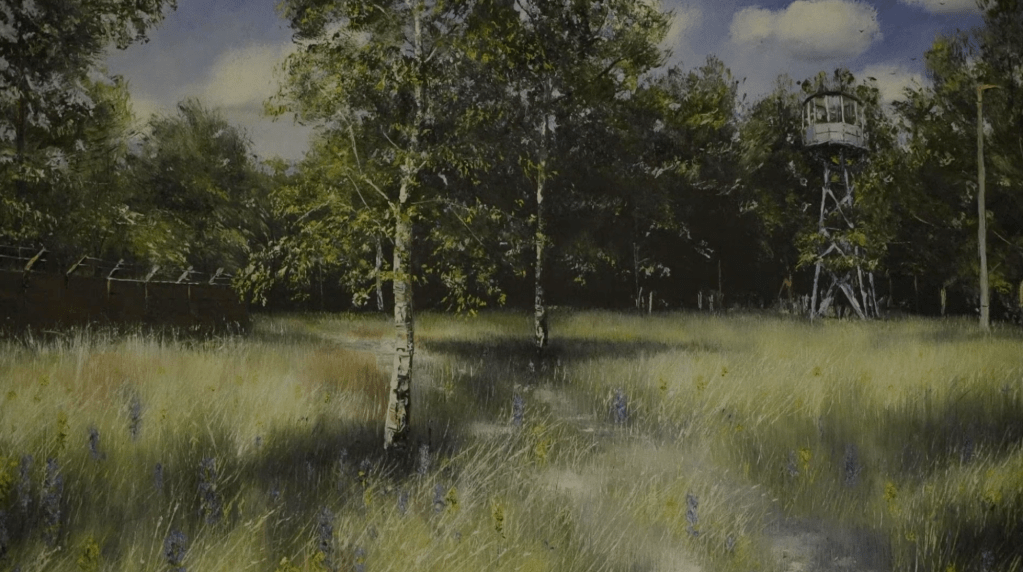
“The focus of my creative work is on psychological horror as it enables me to marry my interests in the uncanny, the occult and psychoanalysis with my love of film.”

With an intoxicating mix of religion, identity and mythology how did you come to write the ‘The Devils Harvest’?

I have a large reference library full of weird, macabre and counter cultural subjects that inspire me and I love horror in all its forms and directors such as Lynch, Strickland, Kötting and Deren among others whose works are both intensely personal and irrational. I rarely remember where my ideas come from and I often wake up at 4am and write them down on my phone before I forget. It’s not a reliable method but I think the most important thing for me is filling my head with the stuff that interests me and eventually something rises to the surface. A sort of a guided intuitive process rather than a commercial approach and ‘The Devil’s Harvest’ was one of the ideas and that became my short film in the first year of my Masters.

How did your Masters degree enable you to actualise all of the ideas you have?

I decided to undertake the Masters in Filmmaking at Raindance Film School which was very much self-directed, so I was able to design my own pathway and focus it on developing a way of connecting the ideas I was gripped by to a working practice. During my undergraduate degree I read Freud’s essay on the uncanny which really spoke to me, touching on subjects I found fascinating. Leading on from this I decided to explore the subject and write/direct a short film with folklore overtones. I also started exploring art and photographic references and building a lookbook for the film. It was an intuitive process but guided through the course structure and the support of mentors like Kate Shenton and Ruth Paxton

The MA program at Raindance seems to have fitted perfectly to your needs – is it a course you would recommend for others trying to move into directing?

I definitely would not be where I am without it. I’m not a very good blagger and I need to know what I’m doing and I’m also a bit of a theory junkie. On the first day I was told ‘you are now professional filmmakers and you need to treat yourself professionally’ – an empowering thing to hear. I am vastly different now than I was before in terms of confidence and knowledge but, mostly, in terms of approach. I now have a proper way of working. I don’t feel ashamed of saying I’m a director, modest though my track record is. During the MA I researched directing in depth and now I feel I know what I am doing when it comes to directing dramatic work as opposed to a thirty second viral. As long as I can use the theory I learnt to support the films I want to make rather than shoehorn the films into cookie cutter theory templates I’ll be happy.
What challenges did you find in the jump from post production and advertising to film writing and direction?

I was struggling to find an artistic practice that helped me create the films I’ve always wanted to make and found the experience frustrating. Whilst I gained a film degree at university my learning was mostly on the job and technical rather than artistic. In post and advertising there’s a division between the directors and the technical artworkers so I knew how to realise the work of other people, but not my own which was very frustrating.

I also was dealing with a weighty dose of imposter syndrome. Alan Moore has a writing Masterclass on the BBC and he talks of the Wand suit in the tarot and its relation to will. You can have great ideas but you need will to see those ideas through to completion. A great idea in a pub can be the most amazing film if it’s never actually made and that, a little painfully, resonated with me. You have to earn everything so putting down the bottle and facing up to the fact that no-one was going to do it for me was an important personal step.

How did the script progress from the aforementioned ‘unreliable’ method of jotting down ideas at 4am?

I initially wrote the film as a short story and then screenplay and directed the short in the summer just before lockdown. As it was part of my MA my timings were very tight and I worked on the script for about 3 months, looking explicitly at visual subtext as the language that sits underneath the film and helps convey all the elements below the plot. I was looking into themes, visual motifs and symbolism and how to add weight to a film which is a tricky balancing act. Robert Mckee talks about image systems in his book ‘Story’. What you really want to aim for is generating your own symbolism within your film rather than relying on external symbolic sources. You also need to strip back anything that doesn’t have a loaded meaning so you don’t weaken your thematic message. Don’t hit your audience over the head with a message, they want questions, not answers.

In terms of writing I used Dan Harmon’s ‘Story circle’, a lot of people hate story structure methodology as they think of it as constricting and/or commercial. However I found it helps to be aware of it, then write organically, returning to it during rewriting to see if it helps fix things that aren’t working. I don’t buy into the ’you need to hit this beat on page 3 and the midpoint has to be page 8’ but I do think knowledge of these models can help fix things that aren’t working.

Even outsider filmmakers have clear structures in their work. It always amazes me that no matter how alternative any particular film is, you can still see the first major plot point happening around the 12 minute mark. I like to think of filmmaking theory as a toolkit that you can use if and when you need it. You can also challenge it. It’s the old cliche about jazz. Know the rules first before you throw them out.

You have mentioned various directors draw inspiration from – who do you look to as some of the greats in writing and directing and do you think they follow the theory you have spoken about?

I love most cinema and I’ll happily watch a blockbuster as much as an arthouse film. That said, too many blockbusters can feel like empty calories. I’m a big fan of David Lynch though I cringe a bit when I see too much influence of his stuff in my work. I also deeply admire Paul Thomas Anderson, Tarkovsky, Fulci, Kubrick, Park Chan-Wook, Andrew Kotting, Louis Bunuel, Mark Jenkin, Julia Ducournau, Argento, Peter Strickland, Roy Andersson, Ari Aster, Robert Eggers, Maya Deren, and Hitchcock and anyone whose work is psychologically driven. Overtly political stuff tends to leave me cold as I’m just not built that way. That said, the Zizek documentaries on cinema and ideology are great.

As for if they follow theories or not, I don’t know. I know Ari Aster is a student of Peter Markham who’s written a very good book on script analysis for Directors. Scorsese did a great three part series on Classical Hollywood cinema and Gilliam did a great series on Early Cinema. As I also love horror, Mark Gatiss’ documentaries on horror for BBC4 are outstanding.

We’ve heard a lot about your theory and writing, what about the more practical elements in the shooting of ‘The Devil’s Harvest’?

Production for ‘The Devil’s Harvest’ took 3 days starting in some community owned woods in Uckfield which saved us having to compete with dog walkers and joggers. As it was outside and we had a cast and crew of about 20, I organised hot food to be delivered thanks hugely to my partner Anne. I couldn’t pay anyone so I had to feed them well! My brother, Luke, is a games producer and an organisation whizkid so I pulled him in as production manager and he helped run the show along with Thom O’Driscoll, the First AD. After unfortunately having to part ways with my first DOP I put an ad on shooting people and found Jonathan Nicol who had a superb showreel and we both had the same vision for the film. Jonathan really upped my game, the Director/DOP relationship is a complex one as it’s never the same. I knew with Jonathan that if I stepped back or slacked off at any point he’d jump in and take over. I don’t mean that negatively at all. He was just super efficient, creative and professional. The sound recordist and mixer was John Valledy who I’d worked with on some corporate work. We’d bonded over Lynch. He did a great job, particularly with the sound mix. A very good and long time friend, Jeff Stonehouse, who is an ambient artist, created the music bed and we weaved that in with the mix to keep things organic.

When it came to the edit I cut the film myself in Final Cut Pro (sorry, Premiere fans) and, through an old contact of mine, Andy, was lucky enough to get it graded at The Moving Picture Company in Soho by Philip Hambi. We hit it off straight away and it was an amazing experience to be able to sit in a suite grading my film in the same building that worked on Dune, Blade Runner 2049 and other massive features.

Can you tell us more about your experience of working with the actors?

At the time I was less comfortable working with actors than directing camera so I consider myself lucky that I had such good talent involved. Fintan Shevlin and Cerys Knighton I’ve worked with previously and they are both very gifted and professional. I had them in mind from script stage. Matthew Jure who played the dad was a firecracker in terms of performance and gave me loads to work with. Dave Pepper revealed a green man tattoo on his arm at the audition so I knew he HAD to be my Rotten Man. I pay attention to those kind of synchronicities. The two boys, Sam and Monty, were absolutely superb – it wouldn’t work without them – and they handled the shoot day like professionals.

What do you hope for your film?

I feel that ‘The Devil’s Harvest’ is the first film I’ve made that really expresses who I am as a filmmaker. The process I developed on the course helped me join the dots from the initial idea through to the finished film. Of course, I see things that bug me about the film that I’d like to have done differently but there’s no point looking backwards. As a good friend of mine says, wipe your mouth and move on. I developed ‘The Devil’s Harvest’ idea into a feature script which became my final dissertation piece and I’d love to direct that some day and I’m trying to work out the finance now, how to step up to a feature. My plan is to keep my ideas complex but the practicalities simple and cheap. As I love the uncanny that’s not so tricky as it needs to be grounded in reality rather than involve huge CGI work. In the meantime I’m working on another short that blurs psychological realism with the supernatural and a micro budget feature that’s a cross between Funny Games and Invasion of the Body Snatchers. I’m excited about both of them and that’s a good place to be. It’s lovely to have the film in festivals but, as Alan Moore says, the important thing is to keep going and get the damn things made. I may have found my voice a little late but I’ve only just got started. Hopefully what I do will be good and other people will like it.

Interview with Mark C. Hewitt, Director of ‘Les Coffrets: Boobs’

Inspiration can truly come from anywhere as shown by Mark C. Hewitt, a freelance playwright, poet and stage director, who launched into the writing of a surrealistic sequence of poems which he then decided to use for the basis of a series of stylised films all under 90 seconds. With the overarching title: ‘Les Coffrets’, Hewitt’s 8 ritzy and enigmatic micro films mimic the structure of his poems. The pieces have received audiences at festivals the world over, and Hastings Rocks International Film Festival is proud to be showing two of these: ‘Boobs’ & ‘Camp.’

We spoke to Mark about the beguiling ‘Boobs’. He tells us that the writing of the poems was challenging, “sort of a game, but a game with particular rules”. Whatever these rules are, they have led to a truly unique and innovative series of films, with each one standing alone in its own right . The artistic collaboration between Mark and filmmaker Matt Parsons seems to break with any conventional notion of directing and has pleasantly led to the extremely clever and enjoyable films inspired by the neo-noir vignettes of the 30s and 40s, with no conventional message. Who needs one?

Be driven by what you love.

What was the initial idea behind the films?

The films were conceived as the visual online counterpart to a quirky, slightly surrealistic sequence of poems which I had written, with the title ‘Les Coffrets’ (meaning ‘the boxes’) which comes from the shape of the texts on the page. Small boxes of thirteen and a half lines surrounded by a lot of white; each line approximately 34 characters long. There’s eight poems in the sequence and they have other particular features, most notably that the final phrase is something overheard. In the same spirit, the texts also use other chance elements, such as phrases seen on clothing or in ads.

How were you inspired in the writing and structure of the poems and then developing them into films?

The shape of the texts was influenced by something I thought I saw by Canadian poet Anne Carson, whose work I love. I was pushed by the desire to embrace chance and reject a rational authorial development of the texts. In 2019, I got a Developing Your Creative Practice grant from Arts Council England which allowed me some budget for the project and the idea of making a few film poems alongside this collection was part of the Arts Council project. I finished working on the collection of texts around the end of 2019, and was drawn towards the sequence of ‘Les Coffrets’ as material for the video project, partly because they were very short and the idea of a collection of micro films appealed to me.

The works are intricately created together with filmmaker Matt Parsons, how did you two come to be working together?

I was already committed to working with artist filmmaker Matt Parsons because I’d worked with him once before on a performance project made with addicts in recovery and I like his cleverness with using text visually and treating footage etc. In early 2020 I had a few meetings with Matt and I’d already decided I didn’t want the moving image material to be ‘illustrational’ of the texts. Matt had tried a couple of things that didn’t really appeal and I realised these little poems are so off-the-wall that they don’t really suggest any clear visual counterpart. I have this personal maxim: ‘Be driven by what you love’. And in the end, we sort of followed that and allowed my artistic sensibility or personal aesthetic be the key that opened up the project. We talked about shadows and doorways and abstraction and I expressed my love of the textural qualities of old 30s/40s film noir. This led Matt to start exploring out-of-copyright black and white footage from that period, and being the meticulous artist that he is, sifting through hours and hours of footage to find images of shadows moving across walls and doors opening and closing etc, so sort of creating a bank of potential material we could use.

Not long after this, the pandemic went crazy and suddenly we were in the first long lockdown of 2020. We had made key basic decisions about how we would move forward with the films but Matt still wasn’t entirely sure about how I wanted him to use the footage. I referenced my love of early surrealist photography as one thing he could draw on, which I think helped free up his thinking in a narrative sense. I also sent him a list of keywords and suggestions that I felt related to each poem. For ‘Boobs’ I said to him: “baroque 18th century architectural features, opulence, statuettes, caryatids, scrolls, exoticism, pagan kitsch”.

Drawing on those aforementioned keywords was the particular inspiration beyond ‘Boobs’?

In my work as a theatre maker and stage director, I directed a one man show by Caribbean-British poet John Agard, called Roll Over Atlantic, which we toured fairly extensively in the UK. After a performance at Nottingham Literature Festival, we were taken to a nearby pub by the festival organisers. In this pub, I overheard a woman say: “It’s alright, I’ll get my boobs out, you’ll be alright.” So, of course, I wrote this down in my notebook. It became one of many overheard phrases that were available for me to use when it came to writing this sequence of poems and was sort of irresistible. With ‘Boobs’, the whole invented narrative was about making that one line work plausibly. It’s curious that when I put these works on Vimeo, ‘Boobs’ attracted way more interest than any of the others. (Can’t imagine why.)

What direction did you give for the voicing of the short

I had come to the conclusion that I didn’t want the pieces to be spoken in my own voice. Some, I realised, clearly asked to be spoken in a female voice. The first piece I asked an actor to voice the text for was ’Premium’ which I imagined might sound good in the voice of actress Melissa Sirol, a French performer with whom I’d worked on a previous theatre project. As soon as Matt and I heard Melissa’s rendition of the text, we knew it was right. Her European accent connected with the noirish black and white feel and it just somehow gelled. So I started thinking about each piece and asking other actors who I knew if they would consider voicing one of the texts. With ‘Boobs’ I first got a male actor to voice the text, then afterwards changed my mind and decided it should be female. I had involved Isabella McCarthy Sommerville in a bit of R&D once and felt her very cut-glass clear English diction would work well for the piece, which I think it does.

Film noir is beautifully apparent in the works, who and what types of film and work have inspired you to be making the material you are?

I do like the textural qualities of 30s/40s film noir. I was also influenced by early surrealist photography. There must be a whole complex of subtle influences and inspirations behind these works but I find it hard to identify in any clear way what they are. When I recently met with Matt he said he had re-watched them all again and liked that they were so weird and unapologetic and also felt that they seemed a bit Lynchean.

What do you hope for in your films?

After we’d finished, I had no particular idea of what I was going to do with the films apart from put them on Instagram. Normally I’m busy working on stage productions but in late June we were still in lockdown and that was not an option. I eventually started looking around at film festivals and discovered FilmFreeway. In due course, I started sending them out, one or two, here and there, and soon discovered that the best chances of getting them accepted was to focus mainly on festivals that have a super short or micro film category. They’ve now variously been shown at 35 film festivals in 18 countries, and the most successful of them, ‘Premium’, has been a category winner three times. I guess, for me, the important thing about this whole project is the way it’s opened up the possibility of working in film and putting stuff out digitally as a parallel to my other artistic activities. I’m now interested in seeing how my drama writing can work within a film context, maybe creating pieces that have both a live outcome and a digital/filmic outcome. So, it slightly changes the way I might conceive future projects. I have a monologue project with the working title ONESIES that I’m planning to develop in this way.

‘Les Coffrets’ is showing at 3.30pm on the 23rd of April at St Mary in the Castle as part of Hastings International Film Festival.

Interview with Sarah Wishart, Director of ‘Excluded’

One of the wonderful things about our modern times is that more and more voices are being heard on issues that desperately need to be addressed. . Whilst there is a long way to go, in 2018 a group of determined South London students started a movement for #EducationNotExclusion by using the London Underground to make a powerful and subversive statement about exclusions on GCSE results day. A Tube map from ‘school to prison’ could be seen on Northern Line trains, shining a spotlight on the number of pupils permanently excluded from school each day. The satirical poster shows a direct line from ‘sent out of class’, stopping at ‘permanent exclusion’ and with ‘prison’ as its final destination. People were forced to take notice and address a huge problem in the education system over the whole of the United Kingdom. Dr Sarah Wishart, the creative director of a UK-focused charity EachOther, directed the impressive and important documentary ‘Excluded’, shown at Hastings International Film Festival, and captures voices we need to hear as well as setting up a collaborative and informed environment where the young people featured on the film were all involved in the creative decision-making and are listed as co-creators.

A clever, admirably collaborative and thought-provoking first feature documentary where we are not focusing on politicians or journalists, but giving young people the floor so that the audience hears from those directly affected.

S.S: What is your background and what brought you to documentary making?

S.W: I have a background in performance art with a PhD on collaborative artwork and the processes of how they get made. I work with film, sound and text in my practice and so this job is a weird melding of all my skills and knowledge. EachOther is a human rights space for digital journalism so I find myself involved in all sorts of formats. We historically have made short explainer films about rights issues. This was our first feature length documentary and it was amazing to do.

S.S: Where did the initial idea for the film come from?

S.W: Originally I’d been looking to expand onwards from my film project funded by the EHRC with young children talking about human rights. We visited four Rights Respecting Schools around the country in the process of creating ‘Fair Play’. However, the minute I heard about the ad hack about school exclusion that took place on the Northern Line in the summer of 2018, everything changed. I originally thought the format of the film would be the journey into finding those young people and their story, but I actually made contact with them very quickly which totally shifted the whole project. My desire to look at education with young people around rights grew into a film project that listened to what these young people wanted to talk about in relation to rights, and that was exclusion.

S.S: How did you go about developing the idea after reading about the hack?

S.W: I tend to find that the restrictions on a project are what develops the project. Who can be involved, how do we pay them, how do we film etc. and restrictions on this project were fairly significant! It was initially a passion project that I hoped we could get some funding for but until we found any money, I was eeking out shoots around other work we had on. Just as we found out about a small amount of funding, the pandemic hit. We were just booking filming time in Scotland and we had to completely rethink what we were going to do. I sat with the idea that perhaps we had to give it up, but I was working with a fabulous producer who told me about how her partner was sending microphones out to guests on his show – and we followed suit. We bought microphones and sent them out to all the young people, and started all our workshops on zoom.

‘Excluded’ – Kadeem

S.S: You mentioned it was a relatively easy process but how did you find the young people who you ended up working with?

S.W: We worked with partner organisations, as we aren’t a client-facing charity, so we have to build relationships with other charities and individuals working in relevant spaces. Some of the young people were then introduced to the project through their friends who were already involved. Two young people I met when I was presenting our work at a young people driven event in Leytonstone. 

It always takes time to find people who want to get involved with a project like this, and time for the organisations we engage with to build our project into their own timelines. People have to feel like they understand what we and all our team are going to do and how we’re going to work with the young people. Time is a huge issue.

‘Excluded’ – Joe

S.S: When you sent out the microphones how were you directing what was being filmed from afar?

S.W: We’d had workshops with all the young people and circulated questions and ideas back and forth. We also worked with some of the young people’s youth workers and on occasion, these guys helped with the interviewing.

S.S: What were the advantages or perhaps pitfalls of working this way?

S.W: It was an amazing feeling to work in this way – to stand back and enable other people to be involved in a way they weren’t expecting. In relation to the pitfalls, time is always a massive issue. There are inevitable delays when you’re working with such a varied and far flung cohort. Some people needed more support so that took time to enable.

‘Excluded’ – Betty

S.S: The collaborative approach is perfect for this film. Can you talk us through some of the workshops and what the students brought to the table in terms of the actual film making?

S.W: We started with an initial brainstorming session to establish trust, discover what participants anticipate the film could achieve along with listening to what they want it to achieve and enable the space for discussion about how they want to be involved. We also saw this as a useful opportunity for discussions about consent and to get input around creative themes which could run through the project. We focussed primarily on listening to the attendees with only a few open questions to guide the workshops and give them a loose structure. We circulated in the session a rough cut of the footage we had already shot to give them a sense of what the project looked like and to anchor the discussion. After they’d watched it in the session, we dedicated a good proportion of the session to getting feedback on the film. We then opened a discussion centered around those questions. 

From the workshops we identified that the young people wanted us to include spoken word, photographs of some of the young people throughout their education, and a letter from one of Natalia’s uncles who had ended up in prison after his exclusion. The group felt like we needed to include more detailed stories of exclusion and so we asked for nominations of people whose story they thought should feature. A number of names were put forward from within the group and they also requested that youth MPs of some description were included. Although we approached several young Mayors in London, we found greatest engagement and interest when we approached the Scottish Youth Parliament. We discussed sending out audio recording equipment which is how we captured several of the voices throughout the next year. The young people felt there should be a narration track and that a young person should do that “in terms of the voice-over it is quite important that it should be a young person that does it, to really be able to capture the story, it is ok to drill home the points that are most important.” We implemented all of these aspects so the workshops and the co-production they allowed were therefore absolutely central to the development of the film.

‘Excluded’ – Jordane

S.S: Using the stop motion to hide identities works so well. Who did you work with on this and what guidance did you give as director?

S.W: This was done in-house by my film producer Jack Satchell, we decided we wanted to try and summarise the actions of the ad-hack whilst keeping everything anonymous. I absolutely love stop motion and have always wanted to work on an animation project with stop motion animators and Jack, who’d never really worked with this kind of format before, jumped at the chance to illustrate it. It was great finding a tube train model!

‘Excluded is showing at 1.30pm on the 23rd of April at St Mary in the Castle as part of Hastings International Film Festival.

In Review: ‘Stabat Mater’ & ‘Couscous’ by Marina Sagona

Experimental New York cinema might bring to mind Andy Warhol, Jonas Mekas or Maya Deren but whatever your fancy it has the power to stimulate and draw out admiration, contemplation and so much more in the viewer. It diversely tests and breaks traditional aspects of filmmaking thus allowing the director to break free from narrative and to focus creative efforts on the statement being made. ‘STABAT MATER’ and ‘COUSCOUS’ by New York-based Italian Marina Sagona adroitly pay homage to her artistry and explore themes of family, memory and almost overbearing sentiments of longing and loss.

Marina Sagona, Directior of ‘STABAT MATER’ & ‘COUSCOUS’

In ‘STABAT MATER’, a project perhaps bewilderedly named after a 13th-century hymn portraying the suffering of Jesus Christ’s mother during his crucifixion, we are teased with the reveal of a striking nude painting superimposed with a text we see repeating 15 times. The first line appears to be acting as a censor for what is within the open legs on either side. Why would we censor this woman, and what is this straight line actually going to turn into as the text becomes legible? I wonder as a viewer if the religious naming is reflective of these opening frames and where this is going.

The following individual 18 second frames slowly progress to reveal the entirety of the text which we soon recognise as a translation of the chattering we hear between a man and a child. The text itself masterfully brings the viewers attention to the background dialogue fading out as the joyous yet sorrowful sound of the musical composition of the Stabat Mater by Giovanni Pergolesi emcompasses our senses. Sagona describes the nude, a portrait of the artist herself painted by her former husband as “a powerful testimony of my biographical circumstances of the time.” 

The glaring religious significance of the films title and the auditory chorus commissioned to Pergolesi by the brotherhood of Our Lady of Sorrows clash superbly with the aesthetic yet graphic nude figure who, whilst slouching informally on a sofa, screams of discomfort, pain and suffering. It is private, personal and yet undeniably relatable all at the same time and also arresting in its simple repetition. The pain Sagona is clearly dealing with is all over her face, only made more evident with the slow panning from the painting as the text fades away into an indiscernible size.

Sagona’s ‘COUSCOUS’ is an auditory journey with stunning and equally stylish vintage footage exploring the director’s own history and cultural and geographic legacy, spanning Libya and Italy. Sagona hails from a Maltese family who settled in Tripoli in the 1700s during the Ottoman Empire, only to be forced to flee after Muammar al-Gaddafi’s coup d’etat. 

The split-screen film shows an emotional and linguistic decoding of a seemingly simple recipe for couscous which is actually describing and conjuring up the nostalgic family footage which evokes the smells, sounds and recollections of a life left behind. The musical voiceover and images expertly highlight the director’s expertise in visual media and is a true testament to one family’s unique and poignant story. ‘COUSCOUS’ makes me long for a simpler time which might be mere fiction and makes me envious as my family name Smith doesn’t hold quite nearly as much intrigue. Through both films I felt the director’s intentions, struggles and desire to tell a story. Experimental film may not speak to everyone, but for those who are willing to work hard at reading dissonant sounds and images, the end is worthwhile. 

Interview with Alan Cross, Director of ‘For The Love Of Noise’

The often-repeated adage – “it’s not what you know but who you know” is perhaps irksome, but the case of director Alan Cross shows that being in the know and knowing the right people can be the golden combo. Cross possesses a motley and enviable background as a member of a successful band from the 80s, years of songwriting, international DJing and music video direction. After bumping into Kevin Hough who would ably contribute to the writing and production of ‘The Love Of Noise’, he commenced an epic 10 month journey to provide us with a fascinating insight into a twilight world. It is a film celebrating Brighton’s underground and experimental noise scene and the city itself, a lieu known for embracing creativity and the downright weird. Our festival audience can expect alluring drone videos of Brighton, in depth and revealing interviews and most importantly, a rare view of a relatively unknown world.

A UK documentary pulsing with passion, filmed in lockdown where we see a city and people going through trying times whilst the throbbing pulse of noise and experimental music is itching to come back to life before our eyes. 

S.S: Where did the inspiration for the film come from?

A.C: The film came out of a chance meeting in the street during lockdown between Kevin Hough and myself. I was loosely looking for a subject that was music-based to make a documentary about and he told me he always wanted to make a film about the noise scene, so we just got cracking to make it happen!

Kevin is a key player on the noise scene and has an encyclopaedic knowledge of its history and all the precarious components. The scene is firmly rooted in live performance and encompasses a huge spectrum of styles, so Kevin’s knowledge was invaluable in putting the film together. Initially the idea was to put together a potted history, but the scene goes way back to the 20s and even has roots in Italian futurism so it was too big a subject for one film. Therefore we decided to make it more about recent history, mainly the last 20 years. 

While making the film, it took on a life of its own and really became a celebration of the Brighton scene and the diversity of Brighton as a city. It encompasses everything from pure noise to more experimental jazz aspects.

S.S: There are unique chapters and movements to the film – how did you go about your storyboarding and planning for these?

A.C: Storyboarding and planning was fairly fluid. We knew from the start that we wanted to include sections on Brighton’s musical history, a run down of Brighton’s noise venues, women in noise, cassettes, DIY and the future of noise, but while we were interviewing people I was listening out for patterns and themes that we could build on. Some of it wasn’t planned but evolved from those early recordings and into the edit. I spent months of late nights listening to, labelling and tagging all the material. I built a massive library to pull stuff from then just went for it. 

S.S: How did you connect with your interview subjects in a time where going to venues wasn’t an option?

A.C: The first job was to find people who were happy to be interviewed, as a lot of people on the scene don’t want to put themselves in front of the camera. We knew we had to base the film mostly on interviews because the live venues were all closed due to lockdown under Covid. Awkward! Thankfully, Kevin is a big player in the noise scene and plays in Noiseferatu and Three Bald Knobbers among other bands, so he knows most of the key personalities. It’s a close knit family and Kev had the access.

S.S: As it is such an underground scene with fascinating characters, how did you find the right technique to draw out their stories?

A.C: By being as nosey, impertinent and rude as possible! Asking personal questions and threatening never to let them go if they didn’t tell us their innermost secrets!

Seriously – I was genuinely interested to know why people would spend their time doing noise work or performing live in the strangest of ways, so we just tried to get them to reveal the motivation behind it. Their dedication and belief meant I was genuinely curious so we asked! There’s a lot of humour in the scene and there’s a real bond between people making noise – it’s a great group of characters so there’s a lot of love involved.

I’d like to have gone further – I think performing a noise gig also embodies a strong rebellious streak so it would’ve been good to get their take on that. It’s a kind of rage against the machine. We should’ve maybe asked why they feel the need to be so rebellious or whether they think it’s attention seeking, or just being antisocial even? But that would maybe be too much “on the nose”. We went as far as we could in the time available.

In the end we just tried to let the speakers provide us the story they felt most comfortable telling.

S.S: It might seem obvious due to the subject matter but how did you put together the soundtrack for the film and where did the material come from? 

A.C: The soundtrack is mostly made up of tracks from the Spirit of Gravity catalogue on Bandcamp which they kindly allowed us to use when artists gave permission. All tracks are listed in the end credits. There are a couple of sections where I improvised short bits of noise or ambience myself during the editing process purely for the fun of it, or where I didn’t have any music that fitted. You can probably spot those pieces! 

S.S: Among other things you are clearly a very talented drone photographer – were the shots in the film specifically for this documentary and what do you think they add to the film?

A.C: Thanks! Apart from the YouTube footage, which is framed on the screen with a black border, all the other shots were captured specifically for the film. I try to capture a big library or pool of shots before I start editing so that I have plenty of material to play around with in the edit – that’s the fun part.

When we were planning the film, the challenge was to avoid the film becoming an endless string of talking heads so we set about creating entertaining visuals to create as many layers as possible while the interviews played out, and to portray Brighton as the vibrant and diverse city that it is.

S.S: Alongside the stunning aerial shots we see a big dose of  daily street life in Brighton – why did you want to include these? 

A.C: As we couldn’t shoot inside live venues we were shooting scenes of people on the street (the only place crowds could go during the pandemic) and while we were going along we realised we were creating a kind of portrait of the city during the pandemic and it became a story of two worlds: one of the overground Covid world with people wandering aimlessly around the city waiting for a solution to the global problem, and the other a portrayal of the underground night club live performance world we are all missing so badly. 

There’s a duality between the normality of sunny, overground Brighton and its underbelly, home to the darker, rebellious underground noise scene. Hopefully we succeeded in portraying that contrast at least in part with the visual elements. We wanted to give the noise scene a context and show where the scene has its home, whilst also showing the city under lockdown during the day, then moving into night at the end of the film. It’s a sort of contrast between “normal everyday life” and “those crazy weirdo freaks” making wild noise and daring to call it “music”!

S.S: What do you hope for your film?

A.C: We hope the film receives some recognition for showing an otherwise undiscovered part of Brighton’s culture – some awards would be great, but it’s already rewarding to see an otherwise unrecognised scene being documented in one place. We are both really proud of how the film pulls all the elements of the noise scene together into one unique document. We hope we’ve done a good job and that people will find it as fascinating and enjoyable as we did putting it together. 

There is so much creativity out there in Brighton city and beyond, so we hope the film gives due credit and exposure to the artists that we have involved and included in the making of the documentary. It’s a vibrant scene and one we felt needed documenting so people can maybe get involved and create new acts and live performances to showcase their own talents in the amazing venues Brighton has to offer. There’s life beyond the stifling digital world – live music and the analogue audio cassette tape are not dead! 

DIY is available to everyone and costs nothing so we hope potential future artists will watch the film then go out and make some noise!

Interview with Barry J Gibb, Director of ‘The Gift’

We are at the dawn of a new year and January is heralding all its sparkling and freshly anticipated opportunities – but what if you knew that the only thing awaiting you was your final end? Barry J Gibb is an award-winning filmmaker with a beguiling background in molecular biology and neuroscience who has deftly turned his inquisitive and accomplished mind to the world of film, and in this case, documentary. ‘The Gift’ is a meditative exploration of the phenomenal life of the vibrant artist Barbara Bird as she lives through the contemplation and acceptance of her death.

An agonising yet heartwarming introspection into the strength and resilience of one woman portrayed in an unexpectedly beautiful way.

S.S: Where did the idea come from for such a compelling piece?

B.J.G: I’m sort of obsessed with time. Initially, I wanted to make a single film all about time – its measurement (as in watches), its very nature (as in the physics of it) and its perception (the human experience of it). The grand plan was to somehow weave these 3 threads together. I started by interviewing a physicist about the fabric of time. For research I read ‘A Brief History of Time’ so I at least had a grasp of the area and asked decent questions. I then interviewed Peter Whibberley at the NPL, the National Physics Laboratory, to chat about atomic clocks and time. All this was fascinating stuff – I tend to start with areas people feel comfortable with, then I ask more probing questions. It’s interesting, for instance, to ask a physicist about their first memories!

Once it got to the idea of exploring the perception of time, I had all these thoughts about, how does a monk perceive time, or a farmer, a prisoner, a refugee..? But then I wondered, what if you knew you were going to die – how would that affect your perception of time? Ultimately, I think, rather than exploring time, I decided that it was the preciousness of the time we have that was intriguing. Of life.

So I got in touch with Living Well Dying Well (LWDW) – I’d made a short video with them about being an End-of-Life doula, and asked for a little help. I wondered if they might be comfortable reaching out to see if there were any people prepared to talk to me – people who knew their time was limited, that they were dying. After an initial project with someone whom I first met in 2017, LWDW got in touch with me about a woman in Hastings, Barbara. I was surprised by how young she was. I just don’t imagine terminal cancer patients being so young, vigorous and funny. I also loved her Californian accent.

Sam Hill (left, Barbara’s end-of-life doula), Barry J Gibb and Barbara Bird in Hastings

That first interview was a challenge. Barbara cried throughout much of the hour-long chat and it was hard not to feel bad, that I was somehow dragging up unpleasant feelings and thoughts – several times I asked if she wanted to stop but she refused. I think it was cathartic. During the interview, Barbara mentioned wanting to leave her body to science at which point, my mind simply said, wow – imagine filming a single person before and after death…It actually took me more than a month to summon the courage to write to Barbara after that and ask her – and her husband, Mark – if they were cool with me filming them over an extended period of time which would also include her death and beyond. I mean, it’s not a normal ask, is it?!

We filmed over two years. I created a list of events it would be good to film and made sure Barbara kept me in the loop of anything that might be a good film opportunity. People are so guilty of thinking their life is boring, but to a filmmaker it can be gold. One morning an idea came to me as I was waking up that made far more, poetic sense, for the ending – and this is how the film now ends, with Barbara herself becoming an integral part of her collage

S.S: Are documentaries a mainstay for you and how do you feel they can be used to tell a story creatively?

B.J.G: Big Question! Yes, they’re what I live and breathe for. Primarily because I love the creative treatment of reality. Actually, this is tougher to answer than I thought! Let’s start at the beginning – I love reality – there’s nothing more pure, honest and important than the very moments in which we find ourselves. Ever since watching Albert Maysles docs (I met him in New York, which was awesome) and some of the early works by the founders of documentary, like Grierson, I’ve been entranced by the idea that every human, indeed everything that passes through time, has the potential to contain a story within it.

The creative part, for me, is the impressionistic treatment of that reality – not trying to change the reality of the story but trying to use editing as a means of enhancing and finding and playing with the emotional content and beats of the story. I suppose it’s a bit like music – there are the notes but it’s how you play them that alters the feeling of them. At heart, I’m a romantic, sympathetic heavyweight looking to tell the most emotional stories I can with what may appear to be the most normal of situations.

Barbara Bird

S.S: Do you think your background in science has an effect on the way you approach filming and if so how?

B.J.G: Absolutely. Part of doing a PhD is learning to be self-sufficient. You design your own experiments, learn new experimental techniques, interpret your results and move forward. Filming is the same. It never even occurred to me to go to film school – while still working in a lab, I got a Mac, a camera and taught myself how to film, edit and capture sound. I used to practice editing by downloading movies from archive.org and creating remixes, using editing to usurp the original purpose of a film, find the humour in it… I love collaborating on ideas and sometimes in the edit, but I work largely alone. The initial idea for a film can be like a hypothesis, the footage I capture is like the raw experimental data, the edit becomes the real experiment where you attempt to see if the hypothesis was correct or – even better – you discover something entirely new.

Today, 90% of my client work is science based – working with scientific institutions to help tell their stories. My past training helps me understand what they want, allows me to easily communicate with the scientists being interviewed and helps me edit and tell their stories in a way that’s relatively simple, clear and uncomplicated.

S.S: Interviews can be challenging at the best of times, so what sort of questions did you ask Barbara in order to gain insight into her person/character and her intimate journey?

B.J.G: I love interviewing people. I had no idea I was reasonably good at it until clients started commenting on it. Perhaps aided by the fact I work alone, when I interview someone, it’s pretty clear, this is just about them – I am interested, I am listening. I care. With Barbara, the initial interview was trying to cover a lot – her attitude to life, time, death. In a situation like that, you have to tread respectfully – you’d never start with question 1, tell me how you feel about death! The way I structure interviews is much like I’d imagine getting to know a friend – start light and gradually (as you build trust and rapport) start getting emotionally deeper. Barbara and myself touched on her childhood, her mental wellbeing, her first memories, her diagnosis, how she started to prepare for death and, of course, how all this has affected her feelings about the time of her life.

S.S: The music featured alongside this heady subject matter really melds – how did you come to create the soundtrack?

B.J.G: All the sound and music is created using Logic Pro. I’d always wanted to learn how to use that software and the combination of ‘The Gift’ and lockdowns allowed me to do an online course to learn it (very crudely) and then use it to create the sort of feelings and sound I was after. I work with music libraries all the time and I know they are brilliant. But whenever I stood at the edit, this film felt like it needed something of its own – maybe not music, as such, but more a sound that would guide the emotional landscape and help provide story beats as the viewer went through it. I saw the film again recently and I couldn’t really remember coming up with some of the musical beats and pieces but they still felt like they were working (so that was a relief!). I also noticed there’s a sort of religious, choral feel to a lot of the sound – born more of reverence for the subject matter than anything to do with religion. I guess I wanted people to feel they were watching something vital, important – a person’s life passing.

S.S: You spoke about filming over a 2 year period. Do you struggle with such a long league time?

B.J.G: With docs, I think it’s pretty easy to just keep filming and convince yourself you have a film. I didn’t want to waste the opportunity Barbara and myself were sharing – this journey we were on – so I was pretty strict with myself. A list was created of ‘things I’d like to film’, aspects of Barbara’s life and death that I felt would help. When thinking about a doc, I tend to think there are at least two aspects to the story – what the film is about, and what the film is really about. For ‘The Gift’, at a simple level, this is a chronological journey that follows a woman to her death. But for me – and hopefully a viewer – it’s about far more.

S.S: What do you want audiences to take from ‘The Gift’

B.J.G: The film is Barbara’s literal gift to the audience. A viewer may be passively watching her story but at the end, Barbara flips the script and starts to talk about you, the viewer – that your life is like a collage and that means you can change it. So, I hope that people come away from the film inspired by the honesty of Barbara’s journey and also motivated to make the most of the life they have, realising they still have agency to change it, to shape it the way they’d like it to be. I want people to watch ‘The Gift’ and come away more able to cherish every moment on Earth they have.

S.S: What is next for you?

B.J.G: This pandemic has been awful for the world. As a person who thrives on documentary, on being in the room and filming a person’s world, it’s been hard. For personal films like ‘The Gift’, getting access has been harder – most people have barely seen their friends, let alone allowed a filmmaker into their home! That said, there’s something bubbling away about grief. I realise as I write this I must sound like such a downer – what is it with this guy, films about death, films about grief?! But, having looked into the area a little, I think it’s possible to tell an emotionally powerful and uplifting story about humans and what we do with grief, how we survive it and find happiness again.

In Review: ‘UNDER A PAGAN SKY’ by Helen Browning

Helen Browning, director of ‘UNDER A PAGAN SKY’

‘UNDER A PAGAN SKY’ is a documentary that takes a spellbinding look at contemporary druidry and witchcraft in Australia. It shines light on a world you may not know existed and will invite you to contemplate nothing less than the eternal mysteries of sex, life and death.

In fine documentary tradition, you will learn lots of new things from watching this film. Did you know that Yule is the pagan celebration that predated Christmas? That “awen” is the Celtic word for inspiration, also meaning “flowing spirit, the essence of life”? The Egyptian god Thoth is synonymous with eloquence, and Nut (or Nuit in Crowley’s Thelema) is goddess of the sky? Most forms of witchcraft date only from the 1950s? These facts emerge from the adepts’ passionate conversations while they are busy with various aspects of pagan life.

‘UNDER A PAGAN SKY’ is not primarily about facts. It offers us, rather, a stimulating portrayal of a broad cross-section of contemporary paganism, one that entirely dispels – pun intended – mass media’s crass hyperbolic reporting. One might expect a documentary on paganism to have lurid content, and no doubt the made-for-TV version would frame its subjects as oh-so-Australian weirdos. Yes, we encounter nudity in the rituals and meet, don’t laugh, a surfing druid. But the colossal strength of this film is its refusal to sensationalise its subject matter and to demonstrate beyond doubt that paganism is a serious subculture worthy of attention.

From the outset, we learn that pagan culture in Australia has deep respect for Aboriginal communities with their own rich tradition of spiritual rituals. Bilawara, a Larrakia Elder who is famed internationally as a healer and teacher of ancient wisdom, has been involved in many pagan events over the years. She is quick to counter the idea that her rites involve any kind of anarchistic licentiousness. “There are laws,” she insists.” If you are going to conduct your rituals or ceremonies, get permission from the custodians of that particular area.” She is not terribly keen on nudity in rituals as a rule, although this is also possible with consent.

Professor Douglas Ezzy and Bilawara Lee

Douglas Ezzy, Professor of Sociology at the University of Tasmania, provides a lively commentary throughout the film. He informs us that rituals, with masquerade and theatrics, “provide deep, profound, moving, wrenching, amazing experiences” and can be seen as a healthy response to Western culture’s “lost sense of transcendence.” Ritual also has a therapeutic value – “a way of working with those parts of ourselves that we find it hard to change.” It is good to see that Ezzy is not just a theorist but a practitioner too. When asked about whether a parent should be worried if their daughter has joined a local coven, he says no more or less so “than if she’d joined the local Catholic church.” Paganism doesn’t do morality in the same way as religion – but that doesn’t mean it is unethical. It is, in Nietzsche’s term, beyond good and evil.

The diversity of topics tackled by ‘UNDER A PAGAN SKY’ shows how deeply eclectic esotericism is in Australia. The film also looks at how different traditions interpret Aleister Crowley’s cryptic concept of magick. The different strands of paganism, which include new age groups, new witchcraft, folklore, as well as artists and musicians, are all brought together by the desire to be at one with nature. A druid ritual can be as simple as taking a walk in the bush or yes, surfing. The community is engaged in environmentalism in a big way, supporting rallies against the destruction of the forests and effects of climate change, clearly seen in the scorched woodland of New South Wales.

Julie Brett, a practising druid
A wicker man at the English Ale Festival held in the Adelaide Hills

Could the documentary have been more critical about whether the many strands of paganism (Aboriginal, European, Latin, Ancient Greek etc.) truly fit together as a united collective? Perhaps. But the film does extremely important work in challenging misconceptions about pagan worship and, even more powerfully, any crude stereotype that modern Australians are bereft of culture and spirituality. At the outset of the film, we are reminded that “the English brought their calendar customs with them, but they didn’t ever think to be in touch with the land they were on.” Maypole dances, wicker men and Jack in the Green festivities are still widely celebrated in English towns such as Hastings. ‘UNDER A PAGAN SKY’ shows how the pagan communities Down Under have reappropriated and reimagined these hand-me-down traditions and forged a new kind of spirituality – one that is strangely suited to the 21st century. Kudos to Helen Browning and her excellent film for turning long-held prejudices upside down.

‘UNDER A PAGAN’ sky will screen at Hastings Rocks International Film Festival, 24-26 April 2022.

In Review: ‘Queer Blood’ by Alexander Roman

Appearances can be deceptive and ‘QUEER BLOOD’ is a striking example of a film where nothing is quite as it seems. An indie neo-noir set in North Hollywood, this drama features characters whose wants and desires are hidden by their own internal struggles and locations so authentically brought to life and meticulously put together you can’t help but be drawn in.

Nino, played by Roman himself, is brought to us as an affable, gentle and long-suffering soul who merely wants to be left in peace to work. His macho, swaggering boss Reggie, played by Jesse Tayeh, seems to accept him for who he is, and as we see later on in the film, actually cares for him very deeply. However, he is unable to protect him from the continued close-minded mentality and quite frankly disgusting views held by some, in particular a man whose voice we only ever hear – Mr Vega. 

Nino, played by Alexander Roman

A tale as old as time plays out on our screens where we witness Nino being persecuted for merely being who he is at the hands of an aggressive gun-for-hire, Sean, deftly played by Kyle Williams who performs his Neanderthal-like duties with gusto. The violence is truncated by a phone call from someone we might not expect your typical hitman to answer to, and the film unexpectedly takes us into the warm embrace of a fabulously kitsch 70s setting. Grandma, whose character confirms that a woman’s intuition is always right, is played superbly by Holgie Forrester and our formerly imposing hitman’s resolve is downtrodden by someone who knows him best.

Holgie Forrester as Grandma

Nobody wants an ending ruined for them and ‘QUEER BLOOD’ needs to be watched all the way through for the individualities to be wholly revealed and the sweet relief of acceptance to wash over. Roman pays homage to the city where his film is beautifully set as it opens with a glorious montage of times gone by, and his talents as a location scout are fully on display in the iconic garage where the film starts. 

The dialogue is not subtle, as we can listen to in Reggie’s conversation with a guy trying to get stolen cars fixed and Grandma’s frank and revelatory chat with Sean, but these words and personas are merely fronts to the relationships we see blossom before us. The drama could easily be extended to be a feature-length movie, but quite honestly, it is refreshing to see so much packed into 22 minutes and for a world to open up and do a total 180 in that time. I have no doubt Roman will continue to do what he loves and bring more of his individual and earnest content to our screens as he succeeded so well in doing with ‘QUEER BLOOD’.

Interview with Sam Seccombe, Director of ‘LESSONS’

* * *

LESSONS’ won best LGBTQ+ drama at London Rocks 2021. Deservedly so. It begins with an awkward Dan and a nonchalant Tommy the morning after a one-night stand. Tommy picks up on Dan’s nerves, wondering if he hasn’t properly come out. “Are you a virgin?” he asks, half in gest. But after some protracted banter and a much-delayed breakfast, we discover that Tommy has his fair share of issues, having yet to deal with a painful breakup. Gay or straight, the universality of their story hits home, and it is incredibly refreshing to watch a drama that dares to talk in such raw terms about love and loss.

Writer-director Sam Seccombe works in the film industry while aspiring to “truth and beauty in his work and future storytelling.” We interviewed this talented filmmaker to see what lessons we could learn . . .

.JR: How and when did you first get started on ‘LESSONS’?

SS: It was during the first lockdown and I was trying to spend as much time on writing as I could. I had several scripts and concepts on the go, but as soon as I got started with ‘LESSONS’ I knew that it was going to become something. It was an early challenge turning what, at first, was very much a conversation between two people, into an actual short film. Using details like different rooms and various props to explain what was originally just spoken word. With a lot of editing, advice and creative focus, I was able to bring the story to life.

JR: The dialogue and situation are very relatable, as if we are in the room with Dan and Tommy. How did you achieve this sense of realism?

SS: It was important for me that the boys felt like they had their own influence over the script. We workshopped and rehearsed to make sure everything felt natural. The last line of the film was actually improved by Guy Remmers, a demonstration of just how in touch the boys were with their characters. As the film discusses very relevant topics like sexuality and relationships, I wanted to present it in a way that allows the audience to project themselves into the scene. The sense of realism is so prevalent because anyone, however they identify, will be able to find something true and relevant in the film.

Ashley Byam as “Tommy” (left) and Guy Remmers as “Dan” (right) facing up to some home truths

JR: Both actors are fantastic, with Ashley Byam (Tommy) naturally confident and Guy Remmers (Dan) realistically nervy. How did you coax these great performances?

SS: In order to develop Dan and Tommy I wrote up a lot of information on their lives; hobbies, families, starsigns, taste in music / fashion and career paths / ambitions. I knew these fictional boys so well, which meant when it came to casting I was determined to find people who could bring them to life. Incredibly, I managed to find the two perfect actors. Ashley and Guy both recognised many things about their characters that paralleled their own lives and they worked hard to create that connection. It was this thorough preparation and deep understanding of their roles (as well as their acting capabilities) that made working with them such a pleasure and allowed for such impressive performances.

JR: Despite Dan’s protests (that he has dealt with coming out), is this drama, in truth, still about coming out?

SS: I think Dan’s journey in understanding himself is far from over. Everyone is different, so it makes sense that every ‘coming out’ story is different. Dan isn’t struggling to ‘come out’, that is to say, his sexuality isn’t a secret. His struggles lie in his reflections on his past and the complications and influences that led to the delay in his realisation and understanding of himself. He is afraid of what the future holds and concerned about the permanent affects of suppressing his sexuality. Coming out is a part, but not the entirety of what Dan is struggling with. His demons are many-headed.

JR: Tommy exudes confidence, but we come to realise he is brushing thorny issues under the carpet. Dan appears on edge and a little lost, faced with the question of how to be himself. Does one worldview win out over the other?

SS: It’s difficult to know if one individual is in a worse position than the other, as we are only hearing of their hardships from them. One of the issues that both characters struggle with is wallowing in self-pity. Tommy has progressed further than Dan at overcoming this, which is evident in the most heated part of the film. Quantifying emotional pain is impossible, and as their experiences are so different you couldn’t pit either against the other. The film does not aim to do this, but quite the opposite.

‘LESSONS’ is about realising what you need to learn. It shows how we can unite with others, and by owning our painful truths, we can hope to move forward to a better place, somewhere we hope both these boys can get to.

JR: Which part of their dialogue do you think resonates the most with audiences?

SS: There is so much going on in both these characters’ lives, the dialogue covers such a wide range of topics and painful experiences. One of the challenges I had in writing was actually pulling back and making sure there wasn’t a tidal wave of information which would become lost by the overwhelmed viewer. I think different aspects of the film will resonate with different people dependent on the perspective from which you are watching, as well as your own personal experience. You could say that the main theme of the film is voiced by Tommy in his line, “As long as you learn the lessons, otherwise what’s the point of all the pain?” Which basically means that we must not let our hardships defeat us but help us grow. No matter what a person has been through we must try to find the lesson.

JR: Do you agree that we don’t see enough of talk about love and life (aka “philosophy”) in UK drama?

SS: I think the superficial nature of love and life can often dominate our screens. Deeper, in depth, analysis of what love is and what it means to be in love are essential in our understanding of one another. Certainly, there are shows that do a great job of capturing these truths and struggles. Normal People, for example, was a huge inspiration for me while writing the script. I studied its beautiful portrayal of emotion and the way it bewitched audiences without being forthcoming.

JR: Will Tommy and Dan see each other again? Is there a follow-up in the works?

SS: The final scene was actually the first thing I came up with. I always knew it would end with their exchange out the window, echoing the beginning of this strange relationship. I think the only way these boys could be so vulnerable was that they were completely anonymous; they were removed from the consequences of their honesty. It wouldn’t be fair to give Tommy and Dan a “happy” ending because it wouldn’t be what is best for them. What they’ve gained from one another will benefit them far more than a romantic relationship. I wanted to play off the irony that to sleep with someone is so physically intimate, and yet it is actually far more ominous for many people to be emotionally intimate.

Sam Seccombe accepting the award for Best LGBTQ+ Film at London Rocks Film Festival 2021

JR: How has ‘LESSONS’ been received by friends, critics and festivals?

SS: I have been incredibly lucky to receive the support I have. I was very nervous to share the script with anyone, there were moments when I thought it might exist only as a draft, hidden on my computer, or that Tommy and Dan would exist only in my messy scribbles that make up my notebook. I sent it to a friend who immediately responded with excitement and it was her encouragement and analysis that pushed me to make the film. I’m indebted to my film crew who worked so hard. The film has been a way for me to start conversations and discussions that I never would have before. It’s had positive feedback from festivals and this affirmation and success is a blessing. Like I said, I’m very lucky to have the support that surrounds me, and I hope that the level of work I do will only grow and improve with time.

JR: Please tell us about your current and upcoming projects.

SS: I’m constantly working on ideas and have so many concepts on the go and in development I lose track of them with each new plan. There isn’t anything official in the works but my main energy recently has gone into expanding my knowledge of the industry and the aspects of filmmaking I want to improve on. I work professionally in location management for film and high-end television, which keeps me very busy, but is the perfect platform for experience, education and building a strong network in the industry. I look forward to being on set again, where I can sit in a director’s chair and watch my work brought to life.

‘LESSONS’ won Best LGBTQ+ Film at London Rocks Film Festival 2021

In Review: ‘KEITH’ by AF Webb

Alex Webb’s latest work, ‘KEITH’, presents a mycology-infused film about how a man named Keith Eldred and his wife, Margot, came to acquire a declassified site in Norfolk from the Ministry of Defence in 1966. Shot against the secluded backdrop of RAF Barnham 94 MU, the film skilfully merges an array of visual styles that bring together an unnerving sense of British landscape unease, anecdotal storytelling and artefact as archive in a creatively abundant experimental documentary.

Alex Webb (b. 1991) is a British photographer born in London who studied photography at the University of Brighton. His photographic talent is evident in the opening of ‘KEITH’ with a split-screen displaying lush, overgrown shrubs dotted with red berries hazily seen through a camera viewfinder. Setting up the dexterous editing format, the viewer is subjected to rapid-fire analogue montages as the film progresses. Alex’s background as an independent art book publisher is also discernible in the stark red and white diagrammatic title sequence, a reference to nuclear infomercials of the latter half of the twentieth century and the site once used to house Britain’s first nuclear weapons.

Introducing the film is the voice of Keith Eldred himself, layered over black and white landscapes of the sparse compound, reading aloud the classic nursery rhyme, Mary Had a Little Lamb. The poem, which is of Massachusetts origin, has an echo of the British pastoral tradition while also alluding to the film’s promise to eschew linear space and time, in keeping with the rhyme. Keith’s life plays out in sequential segments, with Keith playing his younger self alongside Tom MacQueen in supporting roles. The pair take us through an eventful life, from reaching rock bottom, playing in first division football, national service, land development and romance in Hong Kong, mushroom grower, and the eventual purchase of RAF Barnham (in that order).

As a subject, Keith is a regular fellow in many ways, but he is able to locate and celebrate his inner anarchist through Alex’s photographic eye. The film’s richness is foraged by beauty represented by colour, black and white, Super 8 and abstract image. The audience sways between a prism; a myriad of blink-and-you’ll-miss-it dialecticism that harkens the stark naturalism of war-time Britain, 60s psychedelia and the world in a grain of sand. The finest moments within the film are Hong Kong and Mushrooms, during which the sequences wreak mesmeric havoc on visual expectations, unspooling personal and social history.

“Keep an eye on it… I’m not sure about this nitrogen sample… barbed-wire spools, concrete wall, earth traverse, outer picket post, vehicle storage, RAF picket post, fire shed, football pitch, mess, kennels, fissile storage hutch, plutonium core, Blue Danube, small boy, mushroom cloud…”

Keith Eldred

Thomas Ross Fitzsimons’s score is resplendent throughout ‘KEITH’ oscillating between a powerful sense of dread in line with the nuclear undercurrent of the territory, shoegaze dream pop and sustained synth-minimalism that resounds conjunctively with transistor radio bleeping. Richard Vossgatter’s sound design is also excellent, adding a layer of diegetic sound that carries the film brilliantly throughout its narrative highs and lows, similar to This Heat’s 1979 self-titled avant-garde album that foretells Cold War paranoia.

An obvious analogy with the content and form of ‘KEITH’ is Paul Wright’s Arcadia, which tracks Britain’s complex relationship with its land. Whilst Arcadia is constructed entirely with compiled footage from the BFI’s archive collection, Webb utilises RAF Barnham as its set, exploring one individual’s relationship to his most extraordinary lot. There’s something wilfully industrious in a hand tracing the scars of an outer concrete wall against the lush rolling woodlands shot in transit. Other references that come to mind are Gideon Koppel’s Sleep Furiously, Alan Clarke’s Penda’s Fen and Guy Maddin’s My Winnipeg.

‘KEITH’ exists as an original experimental film-poem. It is formidably dense in its image layering, creating a nuanced portrait of man and land. Abstract but not arbitrary, it’s possible to envision Alex picturing the subject of Keith as a photography publication before realising it as a film. As an artist committed to the enduring topic of place and its multitudinous meanings, I am sincerely looking forward to seeing where his lens goes next and what he might uncover beneath and beyond our strange, dreadful and enduring British landscape.

No.94 (special edition book) coinciding with the release of KEITH can be purchased through Alex’s website: https://alexfwebb.com/keith2

‘KEITH’ was awarded Best Experimental Film at London Rocks Film Festival 2021.

Interview with Rishi Gandhi, Director of ‘Mater Mortis’

* * *

Stories close to our hearts, whatever emotions they evoke, can be the hardest to tell. An entire industry relies on people talking about their feelings and exploring various traumas in their lives, but what if there was a different channel for these explorations? No-one can claim to have the magic formula but director, writer and producer Rishi Gandhi has decided to use film to explore his upbringing. We asked Rishi about his inspirations and followed up with a collaborative interview to really explore the hurt, pain and horror we face in ‘MATER MORTIS’ .

“The film was inspired by my own family’s struggles with my mother’s mental illness when I was growing up. I decided to explore the themes around mental illness in families and the fallout in communication that happens between fathers and sons, in particular in South Asian homes.”

Rishi Gandhi

S.S: Have you always been attracted to the horror genre, and if not, what drew you in? 

R.G: As a child horror truly was not a genre I loved, because it could be genuinely terrifying. That being said, I was always drawn in. It consciously became a genre I loved when I was in college, and part of that was seeing films that drew from the horrors of our actual reality, whether it was consumerism in ‘Dawn of the Dead’, or mental health in the ‘Babadook’.

S.S: Did you struggle writing and directing a story with such personal origins, or do you think the personal side was beneficial? 

R.G: Creating a story from a personal place can be challenging. Sometimes ideas develop fairly easily and other times you have to really draw out aspects of yourself you didn’t really know existed. I think writing from a personal place is beneficial, but the process isn’t always easy.

S.S: What was your writing and storyboarding process, and how much does that change during the filming and then the edit? 

R.G: I initially wrote a short story about ten years before I considered making it into a short film. From the short, I created an outline with the beats and path I wanted the story to hit, and then I worked with my co-writer of the screenplay, Dexter John Scott, to hammer out a short script. From there we refined it in a back and forth process until we landed a finished screenplay. Normally you don’t want to bake in too much direction in the screenplay, but as I would be shooting my own script, we added some specific direction for particular shots. 

For storyboarding, I keep a sketchbook with me from where I thumbnail rough shots based on the locations. From there, I develop a comprehensive shot list. The shot list is what I use predominantly on set to track and make sure I not only have the desired shots, but enough coverage and alternate shots for the edit. As far as editing goes, in my day to day, I’m an editor, so that is perhaps the part of the process I’m most comfortable with. The edit is the final rewrite of the film, so I tend to go in with an open mind, aware that things usually have to change in order for the film to flow well. There were montages in the original script that I had to change for the edit, simply because they didn’t flow. However, this opened up an opportunity to lean into the protagonist’s trauma surrounding his mother, with cut aways to memories of the past, which I think enhanced the layers of the film.

S.S: Your story is so personal it poses the question how you came to work with the team you had and trusted their vision?

I met my main producing partner, Alex Armando Torres, with whom the film would not have been possible, at Yofi Fest 2018 in NY. We worked together on a few short projects in early 2019, which rapidly led to us working on pre-production for ‘MATER MORTIS’ from May 2019 all the way to wrapping our shoot in October of 2019. Without Alex, there would have been no crowdfunding campaign, no locations and most importantly no film, as he was the logistical heart of our entire production. 

I met my co-writer Dexter through my partner. He’s an excellent writer and collaborator who dealt with similar trauma as I did in my life, having a parent with mental illness. He was able to help me draw out these similar experiences and imbue the script with the feelings I was looking for. Finally, Renzo Adler. He’s my best friend and former roommate from college, and he encouraged me to take my original short story and turn it into a short film for ten years. Without his steadfast support and encouragement, I’d never have taken the step to make this film.

S.S: What advice would you give others trying to use crowdfunding to get their projects off the ground?

R.G: I would say do not rush into a crowdfunding campaign. As with a film you need solid prep time. You need to think through the logistics and make sure you can deliver everything before you ever start the campaign. It takes serious effort to do outreach and get people to back your project. Otherwise, you’re screaming into a void with no one caring. One of the reasons we chose Seed&Spark is because they’re oriented around indie films, and they have a training series that gets you started on all the finer points of making a sustainable crowdfunding campaign. This is especially helpful, as running a crowdfunding campaign is like having a second job.

S.S: You want this to be a film talking about your people, the South Asian community, how did this affect your casting process?

R.G: We worked with a casting director to get a lineup of South Asian actors. From there we reached out to the actors whose reels we loved and then rented a spot to carry out auditions for a few hours. Auditions for us were really fun, because it was our first chance to see incredibly talented people bring my characters to life.

S.S: The colouring of the film is very particular, especially the contrast to the present and to the flashback scenes, how was this realised?

R.G: My intention with the look was always to have a clear delineation between shots from the past and shots in the present. As I am also a DP and colorist by trade, I am always thinking about how the look drives the emotional throughline of a film. One of my color mentors, Dado Valentic, encouraged me to push the looks as far and as extreme as possible, which led to the sepia tinged looks of the past, and the desaturated looks of the present.

S.S: The piercing flashes of red and the zombie-like faces are jarring – how did you find the right balance of their inclusion? 

R.G: We were inspired a lot by the film ‘Moonlight’ and used the frightening cutaways of the protagonist’s mother in that film as a starting point. So the cut aways to a moaning, breathing figure were baked in, to show the protagonist’s trauma trying to break out. Where they fit in best really came down to the editing process.

S.S: The dialogue is minimal and the sound design very light. Why did you decide to go this way?

R.G: The sound design is focused on diegetic sound, and the script was light on dialogue as I wanted to focus on the protagonist, Rajan, and his struggle with communicating with his father. A lot of the awkward interactions come down to what’s not said. These strained interactions are heavily informed by things I have dealt with in my own life.

S.S: What is next for the film and its continued festival circuit? 

R.G: Mater Mortis will be on the festival circuit through at least 2022. We won an award for Best Short Horror at Show Low Film Festival, and I’m hoping we pick up a few more. In terms of what is next, I’m developing a different short with another writer/producer, and working on a feature script.

MATER MORTIS’ will screen at Whirled Cinema on Friday 5th November at 11pm

In Review: ‘Mater Mortis’ by Rishi Gandhi

A short horror where an inexplicable disease becomes a metaphor for the trauma of dealing with the suffering of loved ones. 

From the moment ‘MATER MORTIS’ opens on your screen, your senses are stung by themes of familial trauma and you do not have to travel far to see the personal connection to this film.

A more unusual family gathering as depicted in “MATER MORTIS”

Rishi Gandhi has proudly and boldly broken into the world of narrative film with his incredibly personal short where we follow Rajan, deftly played by actor Leo Solomon, and are forced to endure his heartbreak and confusion in dealing with a mystery illness suffered by his mother. Solomon was recently awarded best actor for his work at the Awareness Film Festival and ‘MATER MORTIS’ has been collecting laurels along its journey in the festival circuit. With its UK premiere coming up as part of London Rocks Film Festival, it is our honour to review his work and also provide an in-depth article into Gandhi’s work.

A haunting soundtrack opens upon the flashback of a young child and then a jarring awakening jolts us into the suffering caused by a mysterious zombie-like virus (a common yet all the more horrific theme considering the reality we live in now). ‘MATER MORTIS’, shot in New York state, has all of the trademark notes of a horror film. Sudden and almost hypnotic flashes of a gruesome face, a newsreader describing the vile reality people are facing and the pained and suffered face of his mother, not to mention the ending – which you just have to wait to reveal itself. 

As previously mentioned (see our extended interview), the film is an exploration of trauma suffered by Gandhi with his own mother’s bi-polar disease and the subsequent struggle in handling a relationship with his father. The initial story was written in 2009, but not put into production until 2019. I have to congratulate Gandhi is his ability to look at his own very personal story and translate that into a film where you are drawn into the dark recesses of Rajan’s mind during flashbacks to a seemingly happier childhood. 

You are left cringing at his father’s treatment of what Rajan is going through, with his blasé dealings with this zombie rot, and then the ease in which we see him being able to move on with his life. You can cut the tension in his relationship with his father with a knife. I felt myself spitting venom towards his character yet at the same time, who are we to judge? Everyone reacts to trauma and to seismic life events in their own way and Siraj Huda, who plays the father, does an excellent job of being very nonchalant in the face of hell.

Gandhi stated that he hopes the film “inspires empathy, self-reflection and conversation”, all of which I can agree with, and very much hope to see audiences continue to deepen their comprehension of the film and the topics it deals with. 

MATER MORTIS’ will screen at Whirled Cinema on Friday 5th November at 11pm

Interview with Janin Stenzel and Lena Stamm, Directors of ‘Easy Said Up High’

* * *

‘Easy Said Up High’ is a short drama filmed across three nations during the COVID-19 lockdowns of 2021-22. Directors Janin Stenzel and Lena Stamm also act in the film, which follows the story of best friends Celia and Helen as they maintain a friendship over Zoom, battling all of the things that life threw at them during that weird, surreal time. Locked up in their own homes, Celia and Helen navigate career-changes, dating and exercising. ‘Easy Said Up High’ is an enchanting reminder of all of the things we learnt about ourselves in isolation, and the steps that we take – big and small – to live our lives to the fullest.

Lena Stamm as “Celia” (above) and Janin Stenzel as “Helen” (below)

How did you both meet and begin working together?

LENA: When I moved to London, a friend connected me with Janin to give me some tips, as she had been living in London previously. We went to the same university 4 years apart and apparently had met before, which I wasn’t aware of. We connected so well on the phone that we decided to do something together. I took the train to Paris and we started developing and shooting straight away. 

JANIN:  Lena and I had first briefly met in 2006 at Film University Babelsberg in Germany. I had just started my acting studies and Lena had just finished hers. It wasn’t until 14 years later that our paths crossed again. Lena and I found out that we had a lot in common: we had both worked internationally, living in different cities and establishing our acting careers in countries where we’d had to learn new languages. We started having contact again in 2019 when Lena planned her move from Stockholm to London. Since I had spent 2 years in London I could share some of my experiences with her, to help start her new life in this great city. A few months later in January 2020 we decided to see each other in Paris, where I was living at that time. That’s when we started creating our story about two friends living in Paris and London.

How was it that you both became interested in film/theatre as a career?

LENA: For me it goes back as far as Kindergarden, my first role was a tree in a fairy tale – then came the princess and then the evil queen, and it just went on from there. I always knew I wanted to act, but still wanted to go about it the ‘proper’ way, as in, getting a good degree and then going to Drama School. The filmmaking came later – I thought for a long time, that acting is the thing I am good at, but now I love writing, filmmaking and producing as well. So much so that I now have my own production company Elbee Films.

JANIN: I had always enjoyed acting as a child – inventing characters and situations together with my little brother and my friends. In elementary school, I loved to recite poems and create little sketches in our English classes. I wanted to become an actress, singer or dancer. When I was a teenager I took dance classes, joined several choruses and bands, but my passion for acting grew much stronger. I started acting in drama classes at school and I knew this was what I wanted to do for a living.

How did the idea for ‘Easy Said Up High’ come about?

LENA: We thought we could use our real situation in life; me living in London, Janin in Paris, and develop a story around it. And it started with the location. Janin said, ‘hey, I have a friend who has access to a rooftop where you can see the whole of Paris and Montmartre, how about we let our characters talk there?’ What a fantastic setting it was and so much joy to start filming like that. 

JANIN: When Lena came to Paris, we created a scene between two friends. We got super excited and wanted to shoot that scene straight away. A friend of mine had an apartment with access to the rooftop at that time, and that was the perfect location for our scene. 

How did you manage to film ‘Easy Said Up High’ over three different countries during lockdown?

LENA: This was challenging at first, but once we made certain decisions it was a lot of fun. We decided to shoot from home, with our iPhones and the help of our partners. Yes, they were recruited as props manager, light designer, boom operator and DOPs. 🙂 Sometimes we shot together while connecting via video chat on one device while shooting, and sometimes one shot her part first and the other one came in later. We used the small windows when it was allowed to go outside or to meet people to shoot the scenes where other characters were involved. And when Janin was allowed to fly to Rio, she recruited her husband’s family to drive cars and help out with the equipment. It has been a journey for sure. 

JANIN: Lena and I met in Paris at the end of January in 2020, just before the pandemic started to get serious here in Europe. Then Lena went back to London, and I stayed in Paris. We started developing our story around the circumstances we found ourselves in. Lena kept filming in London, and I shot my scenes here in Paris. Our partners helped us a lot during this process. Luckily, we had just become good friends with our new neighbours, who made it possible for us to shoot the scene with Helen’s neighbour.

JANIN: We actually planned a different ending to our story which was supposed to happen in London with both friends reuniting, but travel restrictions and quarantine measurements made it very difficult for me to go to London. My husband and I planned to spend a few weeks in Brazil with his family so we decided that Rio would be the perfect place for Helen to end up in this story. I travelled on my own to Rio, as my husband managed to go to Brazil a few days earlier, and I had to find a way to shoot Helen’s scenes at the airport. In the early morning hours, I met a very nice man from Italy – Mauro – at the airport Charles de Gaulle. He had just ended his shift and was waiting for his train back to Paris. I asked him if he would like to help me shoot a scene for my short film and since he didn’t have anything else to do, he said yes. He was very sweet!

What provoked you to focus on a friendship rather than say, a romantic relationship?

LENA: That is a really good question. I think one reason was, that we have both been living in different countries for the past 10 years and we know how invaluable longtime friendships are, especially when you are in a new city. And the idea of Celia trying to date during lockdown, was hilarious and so real at the same time.

Arinder Sadhra as “Rameira” in an unforgettably hilarious lockdown dating scene

JANIN: The first idea of ‘Easy Said Up High’ was to tell a story about two friends, so we stuck to it. The pandemic also made it more complicated to shoot with other actors. We could have told more about Celia’s new relationship or Helen’s relationship with Peter and then Gabriel, but it would have become a different film and probably a longer one, too. 

What are your filmmaking influences?

LENA: Greta Gerwig, Hans- Christian Schmid, Tina Fey to name a few. And inspiring recent talks with colleagues, especially from the Women in Film and TV events here in the UK.

JANIN: There are many filmmakers and screen writers that I admire, like Pedro Almodóvar, Phoebe Waller-Bridge and Wong Kar-War, for example.

What were some of the biggest obstacles during the production of your film?

LENA: We never knew when we’d be able to shoot certain scenes. There was one time where we hoped to finish the film together back on the rooftop in Paris, but the rules changed so quickly, as we all know, that we had to go in another direction to be able to finish the film at all. So, we are incredibly proud that after all this ,we got over 30 festival invitations worldwide so far. It seems we hit a nerve with our lockdown dramedy! 🙂

JANIN: A big challenge was finding the right time to shoot while being strictly quarantined. In Paris we had a hard lockdown for 8 weeks, when we could only leave our apartments for one hour during the day. My husband was working from home and our apartment at that time was only 36 squared metres. When Lena and I wanted to shoot a scene together, we had to find a time slot when both our partners would not be in any zoom conferences, working or busy with something else. For some shots we needed them as camera men and for others we just needed them to be really quiet (which can be quite challenging when living in 36 m2).

Nicola Peluso as “Veronica”, the nightmare Zoom boss

What message do you hope to spread with you work?

LENA: I would like to inspire people to just do try out their ideas. At first, I was so hesitant to shoot on my iPhone, because as an actress, I was used to being around high quality camera equipment, but not being able to get a proper camera in lockdown in two countries became suddenly very freeing. Buying some extra equipment and walking around London, Paris and Rio with your iPhone; it’s amazing what you can do with it. I wouldn’t want to shoot all my projects like that, but for this one, it was the best decision and made things so much easier under these circumstances.

JANIN: We’ve made this film during a time of uncertainties and worries. We didn’t know how long we’d be locked in our apartments and we wanted to keep working. It was a good moment for many of us artists to explore our creativity in a restricted space. Often, we create an idea, but we hesitate to realise a project due to circumstances – feeling like it’s imperfect or questioning the quality of our idea and procrastinating. Lena and I had many conversations about how we wanted certain things to be perfect or better, and we agreed that it is much more important to use what we have and make the best of it instead of waiting for the perfect equipment or the perfect circumstances and never to finish our film.

What can we expect to see form you both next?

LENA: I just finished shooting a historical film as an actress in Germany and can’t wait to see the result. As a filmmaker I am developing an anthology about a family from the Second World War to the present day, focusing on transgenerational trauma. It is a very personal story, and I am spending a lot of time talking to my parents and relatives and researching my family’s history. So, no light comedy this time. 🙂 The Swedish-English production I have been working on for a while with a wonderful team in Sweden will go into proper post-production soon, and is planned to come out in Spring 2022. 

JANIN: In Germany you can see me in the mini-series ‘Abgenabelt’ in the role of a midwife on Amazon Prime. This summer I shot a short film in Paris playing a mother during World War II, and I am excited to see the final version of the film. And as a filmmaker, I have a few ideas I am working on… Thank you so much Maisie and London Rocks Film Festival for inviting us to chat with you.

EASY SAID UP HIGH’ screens at Whirled Cinema on Friday 5th November 7 – 9 pm