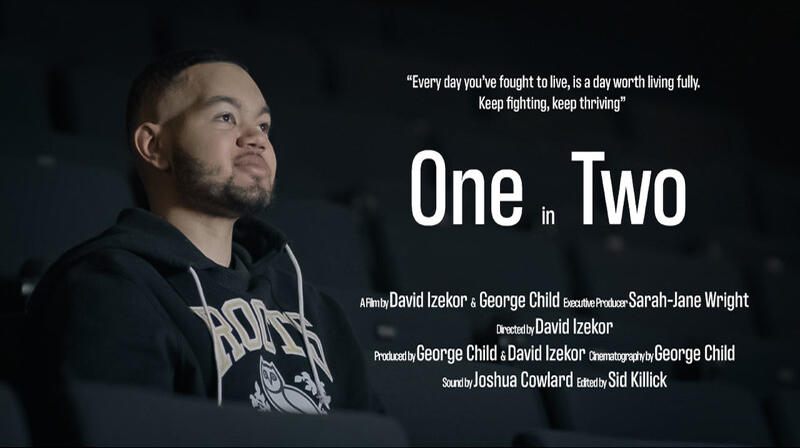
‘One in Two’ is a story of courage and resilience that celebrates the power of human connection. It may make you cry, but it is guaranteed to make you smile too.
As creatives none of us are immune from the slings and arrows life sends our way. But few of us have had to deal with life-threatening conditions at a young age. ‘One in Two’ tells the story of David Izekor, who suffered a haemorrhagic stroke caused by a brain tumour just shy of his 19th birthday. The documentary draws on David’s personal experiences, his doctor’s accounts and testimony of other cancer survivors, Aya and Masha’s mum, Kate, who supported David post-surgery. It also shows how David was able to harness the power of social media to reach thousands of others in similar situations.
*** It is with immense sadness that we have to announce David Izekor’s passing on the 12th November 2025. May David’s energy, creativity, and the promise of a young filmmaker already shining so brightly, remain with all those whose lives he touched. ***
RIP David Izekor, 18/01/2002 – 12/11/2025
Could you tell us more about how you came to get involved in this project?
I didn’t know David at the time of his stroke. He is older than me and was already at university while I was still in college. Where many might have abandoned their studies, David’s determination shone through and he chose to restart his first year, which is where our paths first crossed as it coincided with my first year at Leeds Beckett University.
I have always been passionate about documentary filmmaking. While at college, I began researching a film about the use of cannabis by cancer patients, but many were understandably hesitant to speak on camera. When I learned about David’s story, I recognised a different but equally powerful opportunity: to share an experience that could inspire and support others facing the same struggles. You see, my grandmother had suffered cancer twice in her life, before finally succumbing to it in May 2024.
You and David are both young filmmakers. How were you able to make such a professional, powerful and mature film?
During his cancer journey, which is rare in adults, David met a lady called Sarah-Jane Wright. Sarah was able to empathise with David’s honest and powerful documentation of his highs and lows on social media. Over time, both David and his brother became great friends with Sarah. When David shared his wish to make a documentary about his experience, he introduced me to Sarah as his partner in the production. I’ve been fortunate to work with broadcast-level equipment since the age of 16, and I’ve been using DSLRs, sound gear, and camcorders of varying quality since I was just five years old. These skills meant I could make a strong contribution to the project.
We were incredibly fortunate that Sarah generously agreed to mentor us through the filmmaking process. For more than 18 months, she gave us her time and guidance with unwavering dedication, all the while carrying the demanding responsibilities of her role as Head of Production at Working Title. David and I often felt truly blessed to learn from someone whose experience included serving as executive producer on major films.

Please tell us more about the production process and how long it all took?
From start to finish, it took 18 months. A lot happened in that time. We began this project while in our second year at university. It wasn’t conceived as a student film at first; our desire to tell David’s story outweighed everything else. With Sarah and her team’s help, we launched a crowdfunding page and website and got to work. With support from Working Title and permission from David’s oncologist, we were able to film interviews at St James’s Hospital in Leeds, the place where David received most of his treatment, and in the city we were studying at the time.
We began filming in June 2024. Around then, I also lost my grandmother to cancer. At the same time, I was working on another documentary with my dad, as well as One in Two . During VE Day in May 2024, I was even asked to appear on Sky News in connection with my great grandad and a film I’d made in 2023 which had been screened and nominated at BRIFF. Looking back, staying so busy helped me cope with my grandmother’s passing.
Filming continued over the summer, and we applied to have the project accepted as our final-year submission. By October 2024, with about 70% of the film still to shoot, the university gave us the green light. This allowed us to bring in other students to share the production load (Sid Killick in charge of Editing, Joshua Cowlard in charge of sound and runners Helena Kitchingman and Daniel Liszkovics). Production carried on well into 2025. At one stage, we spent three days filming a reenactment with actors inside the university’s hospital building, material we ultimately chose not to use in the final cut.
Could you bring us up to date with how things are going this year?
Sadly, David experienced a relapse in early 2025. Since we had decided to share a house in our final year, I was able to help him through some very difficult times. He suffered several seizures, and on more than one occasion we had to rush him to hospital. During one of those journeys, the ambulance crew learnt we were making a film about David’s story and encouraged me to keep filming, capturing David’s resilience even in crisis. By May, it became clear David would need major surgery to remove the returning tumour. He managed to postpone the operation until a week after our film’s premiere. On 29 May 2025, we premiered the film at Working Title’s private cinema in London, holding three fully booked screenings followed by a Q&A with the audience.
David is passionate about sharing our film with a wider audience to help young people find their voice in the face of adversity. He continues to maintain a positive outlook, which many refer to as David’s “beacon of light.”
2025 was incredibly challenging for both of us creatively and personally. David’s mobility was seriously affected by his seizures, but his determination never wavered. Together, we pushed through to complete the film, supported at every stage by the university, Sarah and our incredible family and friends. Despite all the challenges, in July 2025 David and I both graduated with a First-Class BA (Hons) in Filmmaking.
What do you hope for your film?
We’ve begun submitting our work to festivals for 2025 and 2026 and are proud to have already taken home a Best Short Film award. Looking ahead, David remains passionate about sharing our film with a wider audience to help young people find their voice in the face of adversity. He continues to maintain a positive outlook, which many refer to as David’s “beacon of light.” Even in his darkest hours, he is determined to support others as well as himself, openly sharing and speaking about the fears that weigh most heavily on him. I will continue to work at making this happen.
 Rocks Festivals Blog