

In the heart of Brighton and Hove, amidst political upheaval, filmmaker Phil Ross, an award nominated filmmaker whose film ‘Portrait’ was enjoyed by audiences at Brighton Rocks 2024, found himself embarking on a surprising and revelatory journey into documentary filmmaking. His subject: Tanushka Marah, a British Palestinian theatre director, mother and activist who made the bold decision to stand as an independent candidate against the Labour incumbent in Hove and Portslade. Ross, fresh from completing his MA in Filmmaking at Goldsmiths College, was thrust into a fast-paced campaign that would evolve into much more than one woman’s political story. As he followed Tanushka and her diverse team of supporters, Ross uncovered a broader narrative of female-led activism, social justice, and the complexities of the Palestinian-Israeli conflict playing out in the streets of Brighton and his documentary has evolved into a story about politics, democracy and how we challenge the power.
Phil details the well known and recognised struggles behind financing such a project and you can support him through his crowdfunder.
The filmmaking process presented numerous challenges. With limited time and resources, Ross had to adapt quickly, capturing pivotal moments as they unfolded. From intimate strategy meetings to raucous street protests, he found himself navigating the delicate balance between observer and participant. The project demanded not only technical skill but also a keen sense of ethical responsibility, as Ross grappled with when to keep the camera rolling and when to prioritise his subjects’ dignity. Financing the project on the fly, Ross invested in equipment and logged countless hours of footage, all while looking to the looming beast – funding. His approach as a documentarian, striving for objectivity while maintaining empathy looks to redress the balance and uphold freedom of speech.
What began as a documentation of a political campaign has evolved into a multifaceted exploration of grassroots democracy, community divisions, and the power of collective action. Through street interviews, campaign events, and personal moments with Tanushka and her team, Ross is crafting a narrative that speaks to larger themes of representation, activism, and the complexities of modern political engagement. In this in-depth interview, Ross shares his experiences, challenges, and insights gained while creating this timely and important documentary, offering a behind-the-scenes look at the art of capturing real-life drama as it unfolds.
Tell us a bit about your journey into filmmaking and how you came to be embarking on this incredible project?
I’ve loved film all my life, but it’s only fairly recently, during lockdown, that I made a concerted decision to give it a go as a new career, and I enrolled into an MA Filmmaking: Producing Fiction at Goldsmith’s College. It was an intense and rigorous experience, surrounded by talented people, sometimes 30 years younger than me. I have to be honest, I struggled at times, but my partner Mel and my daughter Sophie kept me together, along with the sheer joy of making stories.
I hadn’t even thought about producing a documentary. I had just graduated in January, and was starting to put together a slate of drama projects to develop. One Sunday morning, Mel told me that Tanushka had decided to stand as an independent in the next election. Mel is an old friend of Joe’s, Tanushka’s husband, and I’d met them socially a handful of times over the years. Tanushka is a British Palestinian theatre director and activist, who was so incensed that Labour had refused to back calls for a ceasefire in Gaza, that she decided that the best way for her to express her outrage over this, was to stand against Peter Kyle MP, the Labour incumbent in Hove and Portslade, and vice chair of Labour Friends of Israel. Making coffee that morning, it dawned on me that win or lose, what Tanushka was about to undertake was not just bold and exciting, terrifying even, but important. I realised that needed to be documented: her journey would become a small but important part of history. Soon I was speaking to Tanushka on Zoom, “Yes, let’s do it, I trust you instinctively” It was all very quick. In the end it needed to be! No-one knew then that Sunak was soon to announce a July 4 election!
The end of this film is still evolving, but the elements of positivity and a female-led anti racist, social justice movement with Palestine fully to the fore are all there in abundance.
How did the original treatment of the film change during the process as the election took everyone by surprise?
To be honest, the treatment was never a blueprint, just a starting point. I’m a firm believer in the three-act structure, even for documentary, and that hasn’t changed. Structurally, the film was conceived as: the hero’s ordinary world, her journey, and her new changed world. I’d always expected unforeseen elements to arise and for the story to evolve, which it did from the moment Sunak called the surprise election.
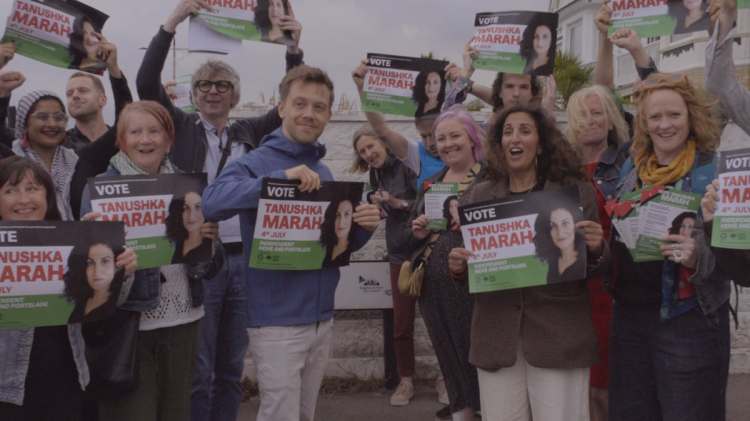
One lovely surprise was that Tanushka was surrounded by talented, organised and motivated women of all ages. From the Greenham Common veterans to the Gen Z social media team and every age in between. Many of them were experienced but disaffected Labour campaigners, including Tanushka herself, who had campaigned for Corbyn. Of course there are also plenty of men in her camp, but it became quickly apparent that this was not just ‘one woman’s story’ but also a women’s story.

One less pleasant surprise for me was to discover the stark divisions that exist immediately below the surface in Brighton, between a pro-Zionist cadre on the one hand and supporters of a free Palestine on the other. I’ve heard many people argue that elements inside Labour manufactured allegations of anti-semitism to oust Corbyn and his supporters and install Starmer. If this is true, then they’ve made an ugly bedfellow for themselves, especially in light of the recent far right anti-immigrant rioting we’ve seen across the country.
Anyone who has attended a march in London will probably have seen the far-right and Zionists flying flags and protesting together. And on the 3rd of August in Blackpool, I witnessed a 1000-strong far-right mob flying a Union Jack and an Israeli flag at the Cenotaph before they were moved on by police with horses and dogs.
Like everyone, I had expected this summer to be a long slow build up to a November election, and I’d imagined Tanushka and her team narrating their thoughts and experiences, rather romantically walking along the seafront and through Preston Park, the last thing I expected was to be filming far-right racists being hounded out of Brighton, surrounded by police for their own protection. It was no surprise however to see so many of Tanushka’s team right in the centre of Queens Road last week facing the fascist thugs.
The end of this film is still evolving, but the elements of positivity and a female-led anti racist, social justice movement with Palestine fully to the fore are all there in abundance. And of course if a ceasefire happens or if arms sales to Israel are halted, then Tanushka, her team and the millions of protesters and activists around the world will have all played their part.

If you introduce a camera to someone, you immediately affect their behaviour.
What is your approach and ethos as a documentarian as you are broaching such a polemic and often polarising subject?
My instinct was to observe and report, in as unbiased a way as possible, but I was aware that true fly on the wall film is a myth. If you introduce a camera to someone, you immediately affect their behaviour. Apart from that, with the election coming there was always going to be a finite amount of time to capture what was going to happen, and I couldn’t physically be everywhere. So, I’ve asked people to introduce themselves, to camera, and tell me their stories. I want the viewer to connect directly with the people and events in the film.
I also didn’t want this to be a campaign film or an anti-Zionist tub-thumping campaign. I hold great respect for the suffering of Jewish people, the persecution and pogroms they have experienced over the millennia, with the Holocaust being one of the darkest periods of human history. However, it seems to me that a right wing, racist and colonialist mindset exists among some Israeli and non-Israeli Jews, which, when criticised, attracts accusations of antisemitism. This has to be called out for what it is, and I applaud Jewish South African politician Andrew Feinstein for his insistence that Israel is an Apartheid state, and similarly the Zone of Interest director Jonathan Glazer who denounced publicly at the Oscars this year the hijacking of his Jewishness and the Holocaust to justify occupation and dehumanisation.
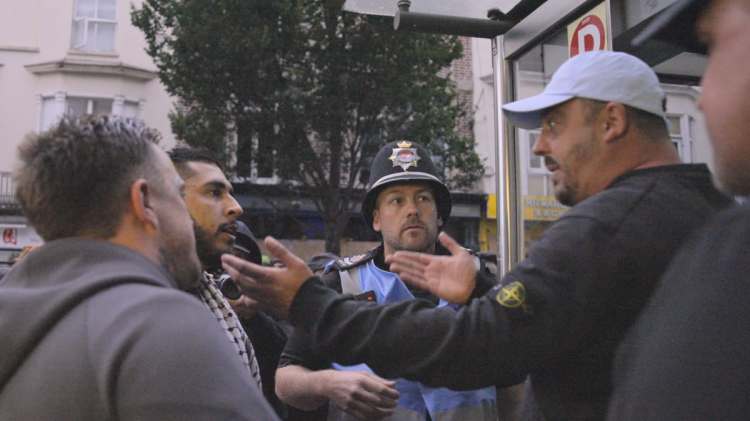
As the election campaign and filming progressed, I was shocked to discover how deeply the Palestinian / Zionist schism ran in Brighton and Hove. People spoke with such anger, and trauma. It genuinely surprised me. Unfortunately, most of the truly vocal refused to talk to camera, but I certainly captured some interesting viewpoints. I spoke briefly with Peter Kyle on a couple of occasions. I said that some “very sensitive things had been said about him, and would he not like to answer some of them”. He said I’d have to contact Labour head office to get their go ahead for an interview, which I will do, and I hope that especially in light of the recent riots, he’ll discuss some of these issues on the record, or perhaps make some suggestions for healing and cohesion back into the local community.
From my own experiences of both racism and religious sectarianism, growing up in the 70s, I was reminded that the peace process in Northern Ireland was to a large extent kick-started by women of both sides, catholic and protestant coming together, and organising peace marches that demanded an end to the violence. This observation increasingly became part of the conversations on the street followed by the question; would you be willing to meet with women on the opposite side to discuss differences?
Can you tell us about interviewing your subjects from Tanushka and her team, to the all important street interviews?
I wanted the subjects to narrate their own as well as the overall story, and I joked that they were ‘the characters’ in the film. I think this helped them to enjoy the process. People are instinctive story-tellers. Tanushka and her team’s experience in politics, trade unionism and activism, coupled with her background in theatre, created an amazing atmosphere and energy, which I hope the documentary will show. People on the street and on the doors were no less animated, when they chose to speak.

I know you have filmed at various peace marches, how do you find the public’s reaction to you as a filmmaker, have you encountered any specific difficulties or push back?
If people are on a march or demonstration, I think they understand that they are volunteering themselves and their image to the world. There are dozens of cameras and phones at any one time, and if someone has an interesting placard, I often ask them to pose with it, but if a person says don’t film me, obviously I respect that.
I find it’s generally right-wingers and Zionists that will shout “Hey, why are you filming? Stop filming me!” They might be prepared, and this goes for both sides, to tirelessly repeat a list of prepared talking-points and counter arguments, which often don’t hold up to any objectivity, but when I introduced a camera, I found it interesting that the right wing Zionists were very unlikely to go on record.
You are aiming for a 70 minute feature and I can only imagine the vast amounts of footage you already have. How are you approaching the edit and pinpointing the footage which you need?
From the outset it was a woman’s journey with everything that Tanushka encounters, and as it evolved into a broader women’s story, then the individual characters came to the fore, Hannah, Libby, Ruth, Molly. They’re all amazing people and will feature heavily in a fascinating blend of personalities, from Tanushka’s celebrity endorsers like Ken Loach, Maxine Peake and Alexei Sayle to the everyday person in the pub and on the street.
Palestine was the inciting element that set the journey in motion, but the social justice issues – NHS, housing, cost of living crisis – all became their own natural chapters. So, it’ll be painstaking to pull out all the quotes, conversations and images but I think a real-life story writes itself to some extent, the campaign shop itself, opposite Peter Kyle’s office on Church Street being a one example, it has a story in its own right; being donated rent-free, being refurbished and repeatedly vandalised – just last weekend it’s front window was smashed. My job as a filmmaker will be to present the story in an interesting and engaging way and find a good satisfying ending.

Funding is an ever present hurdle in independent filmmaking. Tell us how you have managed the production so far and how you plan to raise the necessary funds?
When Tanushka first agreed to make the film in mid-March, I thought I had all summer to approach funding bodies, but with Sunak’s six weeks’ election call, I just had to fly by the seat of my pants and go for it, otherwise I’d have missed the story. If I’d studied documentary at Goldsmith’s and not fiction, I imagine they’d have said: sort out funding before you do anything. So I’ve probably made the biggest rookie mistake in filmmaking, and I’ve run up debt and borrowed money from loved-ones.
I’ve probably spent £500 on parking and petrol coming back and forth from London and about £10k on kit and hard drives, and still have to find money for editing, sound design, music, colour grading etc. to get the film finished. So my pants are still in full flight and I’ll spend the rest of the year approaching funders, while finishing the film, but I’ve started a crowdfunder for now, to keep paying the bills.
How do you envisage the film being able to reach and spark the interest of those outside of the political sphere?
It depends how you define ‘political’, if you remove the left versus right or any ideological element of the political, then in one sense the film is a fascinating window into how democracy really works at a grassroots level, up close and personal. Of course, there were plenty of men involved in the campaign, but at its core, it’s a woman’s journey as well as the story of women, coming together, organising and supporting her and each other. Driven, creative and motivated women, funny and sad at different times and approaching life in the way that women do.
What has been the most challenging part of the process so far and what have you learnt?
Tanushka, her team and her husband Joe gave me the freedom and trust to enter into their lives, and I’m hugely grateful for that. I’ve seen all aspects from the joy and laughter to the tears of despair and perhaps the most difficult thing for me has been rolling the camera when I know they really didn’t want me to be there, or when I really didn’t want to do it. There were occasions when people were very upset, and I turned the camera off, losing poignant shots that would have made great dramatic moments. Balancing my nature as a documentarian with the need to give people their dignity has been difficult and caused me some soul searching.
The distinguished director Penny Woolcock, who I met through Goldsmith’s has been a huge support and mentor to me on this film, said two things at different times. She told me you’ve got to take the camera and follow the story, that’s your job. She also said the genocide taking place in Gaza is the main issue of our times, and it’s our duty to report it. This was my way of doing this.
 Rocks Festivals Blog