

Agency, consent and female rights are understandably delicate and challenging themes to broach cinematically and can be done very poorly. This is absolutely not the case with the excellent and nuanced short film ‘Portrait’ by filmmaker Grace Louey. Set in a South London school, where these exact situations occur with terrifying frequency, a young girl takes back ownership of her body with incredible power and freedom after a nude selfie she took is shared without her knowledge or agreement. ‘Portrait’ is as inspiring as it is upsetting, and writer & director Louey’s personal experience of the subject matter and clear knack for storytelling means that this powerful short offers us an authentic and original glimpse into the story within.
‘Portrait’ came together as part of Grace’s MA filmmaking at Goldsmiths university and the Australian born filmmaker is already making waves on the festival circuit as she won the Rebel8 Outstanding Emerging Female Director award at Flickerfest 2024. The film is in the running for awards at Filmfest Dresden and from the UK’s pretigious Leaning on Screen.It has also been selected for screening at Beeston Film Festival (UK), Fastnet (Ireland), Setting Sun (Australia), Uptilt Festival (USA) and Poppy Jasper International Film Festival, (USA). We anticipate much more news and are excited to be featuring such a refreshing new voice.
When teenager Siah decides to take a nude selfie, she feels both exhilarated and mature. But when she receives news that her photo has been shared, Siah’s sexual agency all but evaporates before her.
I have, sadly, also heard my fair share of these stories. Can you talk about the development of this idea into a script and your writing process with Nina Street?
So many women have a version of this story, but I believe the landscape is slowly changing. The concept of consent didn’t really exist when I went to school and so many women I’ve grown up with have had to deal quietly with a sense of shame over boundaries that were crossed many years ago.
Aside from being personally interested in the subject matter, the story was inspired by real events that occurred in 2016 at a private school in my hometown, Melbourne. A group of boys were involved in a vicious sexting ring and the school gave the girls whose trust they had violated, the ultimate decision on their future. Miraculously the girls chose not to have their classmates expelled or face criminal charges, on the condition they were initiated into counselling on consent. This was the first time I’d heard of anything like it, and I was struck by the show of maturity and compassion but also of female strength.
After completing this exercise and collecting both anecdotal and factual research – we found ourselves drowning in a sprawling story with multiple players, better suited to a two-hour feature, not a short film with a tiny budget.
Nina and I began by writing this idea out in the form of a fabula, laying out the raw material for the world of the story. After completing this exercise and collecting both anecdotal and factual research – we found ourselves drowning in a sprawling story with multiple players, better suited to a two-hour feature, not a short film with a tiny budget. So, we chose to take the essence of the idea and channel this quiet demonstration of female agency into a short film with the same spirit.
We then did some workshops with the South London Youth Theatre. We wanted to work with young actors not only to get an accurate read on youth vernacular for the script but to better understand what young people these days know about consent. We had no idea the script would end the way it does, but we knew that we wanted it to contain a rebellious energy and reflect the spirit of the young actors we met at the SLT. It was a long process of refinement, but we had a lot of fun researching and writing it.

The film, alongside celebrating agency, starts with a non-consensual sharing of pictures. How did you make sure this was portrayed accurately so as to be hard-hitting but not exploitative?
That’s a great question – and I did find myself a little out of my depth in the beginning. We were dealing with both implied nudity, a very young cast and material that demanded an appropriate approach both on set as well as on screen. So, we got an intimacy coordinator involved early on who advised us in pre-production on how to prep and run a closed set. It was both a big learning curve but also empowering, as I truly believed there was a good reason for nudity in our story.
The final scene is a clear demonstration of female agency, but the mirror scene is private. It’s the moment of trust that is later violated and I didn’t want to accidentally exploit this moment in the film through objective camerawork.
I thought a lot about how I would shoot the first sequence when Siah takes the picture in the mirror and sends it. I wanted to avoid the male gaze and so developed some parameters for myself that I felt addressed this. Any shift in focus and camera movement in the sequence would be motivated by the characters eyes, therefore allowing our gaze as an audience to be led by hers. I felt strongly that this was the best way to achieve subjectivity and avoid any objectivity of her body. This scene felt much more important to get right than the final scene in which the character uses her body in public protest. The final scene is a clear demonstration of female agency, but the mirror scene is private. It’s the moment of trust that is later violated and I didn’t want to accidentally exploit this moment in the film through objective camerawork.

I was struck by the mother-daughter relationship, with the younger woman clearly fighting to be seen no longer as a child but a powerful young woman. Why did you want this to be a part of the overall story?
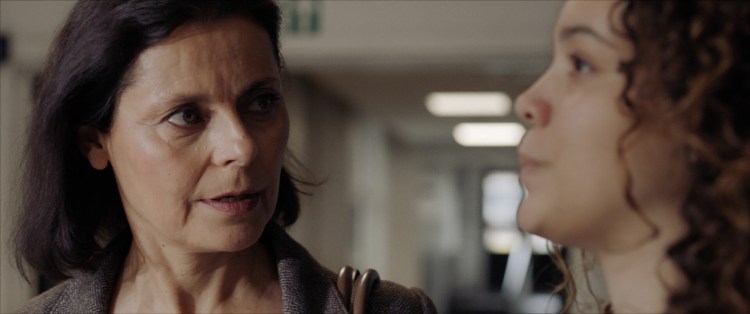
When we wrote the script, the theme of shame kept cropping up. I think each generation has a different relationship with shame, especially when linked to dominant feminist beliefs, which change over time. I think Siah’s mum is old school – to her, the idea of exposing your body for male attention is foolish and ‘un-feminist’. Whereas for Siah, it is pure – it’s about sexual maturity and womanhood. When this is quickly violated by Stephen, Siah and her mother enter into a conflict over who is really to blame and just when she most needs female support Siah finds herself being shamed. When she acts out in the end – it’s her turn to teach her mother something new about female agency. It was important to us that the women come together in the end despite the intergenerational divide. Female led agency was always at the heart of our story.
The NSPCC website also held a lot of very useful information about how parents sometimes respond when their daughter or son are involved in nude photo sharing. Quite often this manifests as anger towards the young person for putting themselves in a risky situation and a failure to understand the process of sexual maturity that their daughter or son is undergoing. Equally the young person needs support from their parents in understanding the risks while undergoing these changes.
Maria Almeida presents the perfect balance between youth and naivety, but also power and agency. What were you looking for in casting and how did you build her amazing performance?
We got really lucky with Maria. She was the result of some last-minute scouting by one of our producers. We needed an eighteen-year-old who could believably play a fourteen year old and we needed her to understand the role of sexuality in the story but perform with a degree of naivety. No one we had seen in auditions had quite nailed the criteria and so we took a punt on Maria which paid off immensely. I wish I could take the credit for shaping her performance, but I think Maria had a strong sense of what was needed from the get-go. She also took direction and notes very well, adjusting her performance with the most subtle shifts that read beautifully on screen.

The film was made as your graduate project. How did Goldsmiths help with the production’s development and support you in the making of the film?
Goldsmiths gave us the structure to build a film, from raising funds in pre-production to taking audience feedback in post-production. But more importantly, the school gave us support throughout the development of the script with a philosophy on constraints. This meant keeping the story contained and therefore manageable and focused. Though, in classic student style, we pushed hard for our over-ambitious ideas. It’s much easier to see the wisdom of their approach in hindsight. If I’ve taken anything from the course – it’s that discipline and refinement of ideas usually end up in a stronger outcome.


What have you learnt and developed in the making of ‘Portrait’?
I learn so much every time I make a short film, but Portrait was a new frontier in dealing with sensitive subject matter. It taught me to appreciate the power of subjectivity on screen in accessing the most intimate of experiences – something I hope to employ in future filmmaking. It also taught me a lot on a technical level, for example, how to shoot a crowd scene with multi-person staging. Though, if I’m honest, I think this could be improved but mistakes are the best way to learn.
What do you hope for the film?
I hope the film gets to be seen by a few more audiences. I always love to hear people’s reading of it. They seem to invest so much more meaning into it than we ever intended and that’s the nicest part of sharing a story – when it no longer belongs to you.
 Rocks Festivals Blog