

‘The Cornucopia Club’ by Joseph Archer is a testament to the filmmaker’s prowess as a director able to absorb an audience into the stylised and rich world he has built – one dripping in satire, stuffed with witty and opportune jokes and oozing with opulence of the worst kind. His short film, inspired by a scene from the script of a feature-length film, delivers a delightfully entertaining watch that shrewdly delves into some of the bigger and more pertinent issues facing us as a society and our acceptance of the world burning around us. Archer worked closely with writing partner Cathy Wippell, who also features in the film, to overcome some of the more unfortunate hurdles thrown at them in the production. The result is a lush, mesmerising dive into topics which make us squirm in our seats and sit uncomfortably in our own homes – and so they should.
‘The Cornucopia Club’ will be playing at Hastings Rocks in April 2024. We look forward to welcoming the crew of Silicon Gothic Films who, alongside producing inventive and thought-provoking films, are commendably working towards creating a more sustainable and forward-thinking future within the polluting world of filmmaking.
In the concept, I didn’t only want to explore the destruction of exclusivity, but also bigger zeitgeist topics such as our relationship with food and animals following the emergence of veganism and vigilantism in animal rights campaigning.
What inspired you to explore notions of class and injustice in this short film?
Britain is a country built on exclusive archaic clubs. It’s one of the huge factors that prevents us from being a truly inclusive class-free country. So I devised The Cornucopia Club, which is no different to any old British organisation. In the concept I didn’t only want to explore the destruction of exclusivity, but also bigger zeitgeist topics such as our relationship with food and animals following the emergence of veganism and vigilantism in animal rights campaigning. And I wanted it to fit the backdrop of decadence and greed, which will highlight societal tensions as we head into further post-pandemic economic-inequality turmoil.
I had the initial concept and had started writing a feature for The Cornucopia Club. It was never intended to be a short film. However an organisation offered us funding and a group of actors to undertake a short version of it. Cathy loved the idea and wrote a short film version of the script based on the characters and story of the feature. Unfortunately the organisation was ultimately unable to come through with the funds only a month before we were due to start filming. Luckily, Cathy and Joe called upon executive producer Lucas. A Ferrara to back the project. Lucas and Joe had worked together before, and Lucas loved the concept so came on board at the last minute.
Comedy truly is the most effective way to discuss more difficult and controversial issues.

Paring down a feature-length film to make a short is quite an unorthodox start for a film script. How did you and Cathy work on finessing this process?
We decided to just focus on one scene from the feature which I think is always a really effective way to make a proof of concept short. Famous examples of it being done are the shorts for Whiplash and SAW. The Cornucopia short script is actually completely new dialogue and copy, rather than being directly lifted from the feature. We used the same characters, themes and setting that I had created, then Cathy took these descriptions and created a new short film script that fitted the essence of the feature. She added her own comedic flair and writing style and we had the short script. When I was directing on the shooting days I worked with the actors to come up with additional jokes or rewrites and some of the biggest laughs we get at screenings are from jokes that we wrote on the day! Ultimately I’m happy with how it’s been crunched down into a short as we get all the essential characters and setting of the feature, whilst it’s an entertaining short-form work in its own right.

You have juxtaposed an old-fashioned and archaic world of exclusive clubs with very modern and hideously-relatable comedy. How did you build all the characters to bring that comedy into a very serious, if subverted conversation?
The best characters can be created from the people you meet in real life.
Comedy truly is the most effective way to discuss more difficult and controversial issues. The most notable and enduring work like this is Charlie Chaplin, who took on the horror of wars and dictators with his caricatures. Each character in the film aims to be its own caricature of the type of people you might meet in Britain, and the disturbing thing is these clubs still exist…but there is a new generation of people in them, who have these modern sayings and current cultural alignment. We based a lot of the comedy on real people we have met or seen in interviews! The best characters can be created from the people you meet in real life.
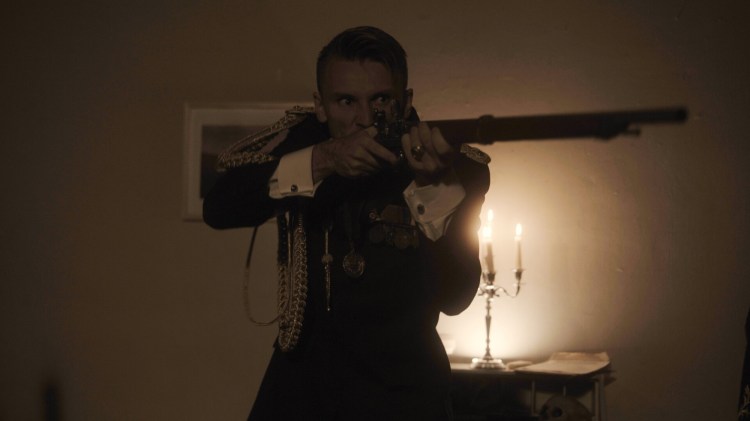
Your website outlines your commendable eco-friendly and sustainable approach to the production, which I think is so important and is certainly something which needs to be looked at by more filmmakers and production companies. Can you tell us more about your approach to this?
We’ve developed this even more going forwards; It’s now part of Silicon Gothic’s manifesto to do at least one climate positive action for each film we do – with our next film ‘Black Samphire’ (which shoots in October), we’ve been undertaking cleanups of the Thames and East Wittering beach, near where the film shoots. We are also getting cast and crew members to sign a “Green Rider” which basically outlines the conduct on set and best practices to prevent environmental damage during the making of the film. We also undertake albert Certification, and will work with albert on all our projects in the future.
For Cornucopia Club specifically, over 90% of all props and costumes in the film were sourced from second hand and vintage shops, or from materials the cast and crew already owned. With tablecloths, picture frames and velvet dresses purchased from Ebay and Vinted, as well as a set of Art Deco glasses from Oxfam, the set and costume design merged to form a fantastic look which would never have been achieved if we’d purchased the materials from first hand sources. Our fantastic set dresser, Andrea Stein, even brought this awareness into the making of the ‘meat’ in the film…of which there was none! All edible meat products were made with various vegan compounds; sweet potato, soy sauce, cacao. And of course, a healthy dose of fake blood.

The colour and tone of the film is so fitting. What were your references and how did you work on achieving the right look?
I always wanted that colour palette and look, but I think I may have been inspired by the candle lit scenes in ‘Barry Lyndon’. I get a bit obsessed with colour consistency. For instance, in our notes the colour palette for the club members was going to be red, blues and dark colours, to hint at an old British nostalgia vibe. While the vigilantes were going to have earthy green and brown colours to hint at their politics and rebellious ideas, as well as their preoccupation with the natural world. So Cathy and I worked together to make sure the production design kept to the brief. The colour grade actually took a very long time to get right but I’m very happy with the final result we got.
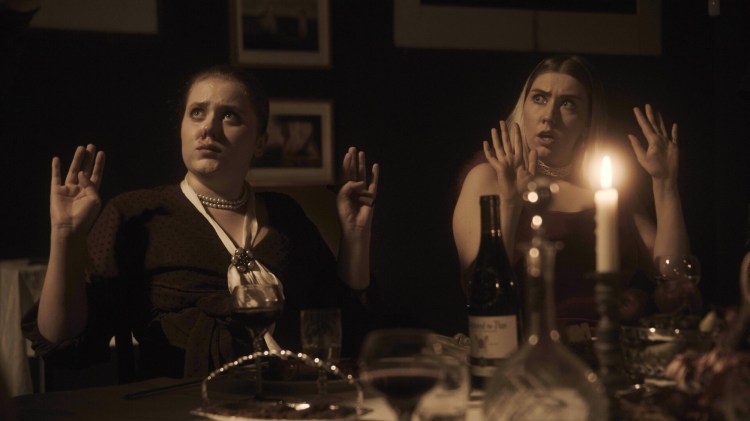
You’ve got some great camera angles and shots which truly absorb us into the feast and mayhem that ensues. How did you storyboard the film and how much of this came in the edit?
For me, kinetic movement is key.
I love coming up with shots, and I storyboarded a lot of it but unfortunately, due to time constraints and budget, we couldn’t do everything I wanted. So, I focused on the main moments to do something fun and special. For me, kinetic movement is key. There was an idea that the style of shots before the vigilantes arrived would feel quite controlled and still (almost dead still!) then after they arrive it becomes more chaotic and kinetic. It almost feels like two different films. To mention ‘Barry Lyndon’ again, the first shot of Cornucopia has a slow zoom out which wouldn’t look out of place in a Kubrick film. This was again to hint at an old England, and the 1970s look of the film’s cinematography and grade.
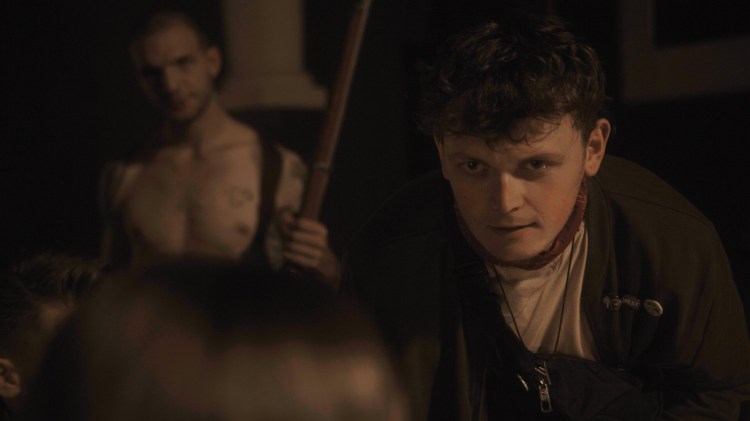
You have a unique purview and way of looking at film production within activism. Can you tell us more about Silicon Gothic Films and what you are looking to build with the company?
The main thing we want to do with Silicon Gothic is tell entertaining stories with modern societal monsters in them.
Both Cathy and I come from activist backgrounds and we’ve always wanted to bring it into our company from the get go. We want to create narrative and fiction work, but we want to do it whilst making a direct positive difference in our world.We’ll be publishing a full manifesto next year that will answer this question properly but the main thing we want to do with Silicon Gothic is tell entertaining stories with modern societal monsters in them, push awareness and action against these modern societal demons, and undertake direct environmental activism with every project.
Additionally, we’ll do this by working with organisations outside of the film industry, such as charities or activist groups. What that means in practice is, for example, with our next short proof-of-concept ‘Black Samphire’ (which shoots in October), the story metaphorically centres around environmental damage caused by coastal pollution. So we’ve been undertaking beach and river cleanups with the help of Surfers Against Sewage, and now River Action UK has come aboard the project as an Executive Producer (which is very exciting!).
So Silicon Gothic is not only trying to help build awareness around the negative environmental impact of our world, we’re actually undertaking a direct positive impact on where we film. It means extra effort of course – there’s nothing glamorous about picking up plastic pollution on a beach – but the cast and crews we’re working with have really gotten into the activist side of the production and find it very fulfilling. If we all do our small part highlighting the world’s problems and fixing them, we’ll all live longer and happier. And I think that’s essentially what we’re aiming to do!
What do you hope for your film?
The concept to be made into a feature, which was the initial plan! Hopefully it will do well on the festival circuit and get a good amount of screenings! Which should hopefully give us the opportunity to get a lot of thoughts from the audience about the idea, which is crucial!
 Rocks Festivals Blog