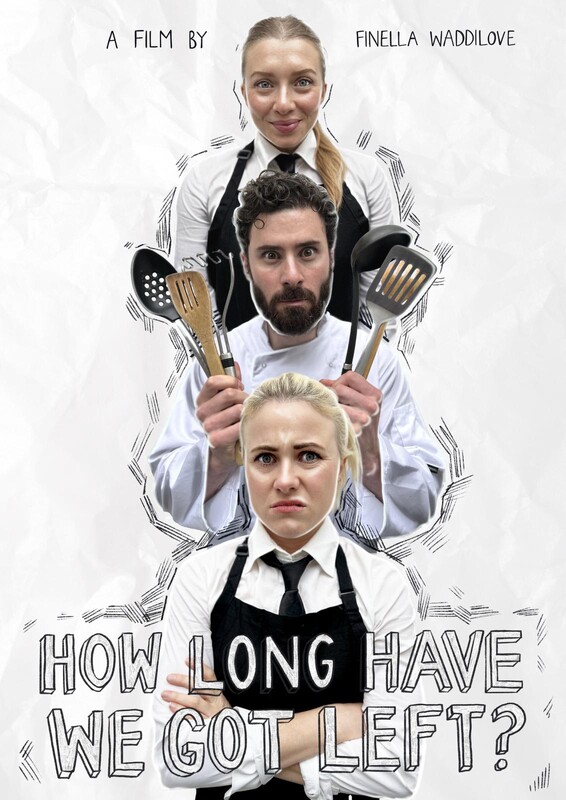
Watching the hilarious short film ‘How Long Have We Got Left’ by Finella Waddilove, I found myself, as I’m sure many others can relate, recalling a time when I trawled through a succession of rather dire jobs. But far from being depressing, it was such a treat to see a film that, thanks to Finella’s excellent comedic writing, makes you cringe, giggle and reflect on your own lived experiences – no small feat.
The LAMDA trained actor used all her skills and hands-on schooling from her first short ‘Smooth Ride’, to bring her second short film to life. Finella skilfully balances multiple roles behind the camera as well as giving a sterling performance as a frustrated and suffering minion of the catering industry. ‘How Long Have We Got Left’ further employs a collection of clever camera tricks to balance the laughter with the harsh reality of the young waitresses’ situation. The up-and-coming-young filmmaker strengthens her comedy with impressive colouring and toning, profiting from the impressive skill set of her trusted team. The result is a short which was thoroughly enjoyed by audiences at Brighton Rocks Festival this year and we wish Finella and the team a well deserved and successful festival run.
Was the inspiration for the film taken from personal experience?
I wrote the first draft of ‘How Long Have We Got Left?’ back in 2019. It actually began as a scene, a stream of dialogue which I typed out on my phone merely as an effort to cheer myself up! I was an unemployed actor, a year out of drama school, living in London juggling multiple jobs. One of these occupations was catering, a trade which, although I truly resented, found to be fascinating and often hilarious: a perfect environment for gathering material. Each shift took place in a new, often very spectacular location/venue such as Sloane Square, Green Park and St John’s Wood. The clients would often have grand demands and expectations, so the stakes behind the scenes were always exceptionally high. There was an immense amount of stress pumping through the chefs, managers and senior staff. They were all absolutely overloaded with dense and obscure ‘to-do’ lists, and had to direct tens and tens of caterers.
I found there to be this hilarious paradox in the formal, high-end nature of the events which were attended by the most glamorous of guests and the just-out-of-uni, begrudging staff serving them. Subsequently, the film was inspired by my frequently bizarre experiences of this set-up; the array of personalities I came into contact with, and my efforts to cope with being deeply fed up and terrible at waitressing.

How did you move from that stream of consciousness on your phone into forming the actual script?
I revisited the script in December 2021, two years after its conception. This was a couple of months following the completion of my first comedy short film ‘Smooth Ride’ which I co-created with Helena Westerman, a best friend I met whilst training at LAMDA. After this incredible creative experience, I was so much more equipped with how to write, and also much more led by visuals and style. It took me three months and eleven drafts to reach my final script, I used the time to really sculpt the three characters and define the different dynamics between them all.
I then went through the piece with a fine tooth-comb and story-boarded each scene, detailing which shots I’d like to use, including references to films that had influenced my decision. I then approached the DP I had used on ‘Smooth Ride’, Simona Pranulyte with the script with the visual pitch package and was thrilled when she said she was on board! We then had numerous meetings discussing the cinematography and how best to accentuate the comedic elements; Simona used her wealth of knowledge to expand my initial ideas. It then took around four days to create the shot-list together. I owe so much of the realisation of my vision to the amazing and quite special rapport I have with Simona. In terms of hiring the crew, I was very lucky to have experienced such great chemistry with my crew on ‘Smooth Ride’, so took no hesitation in contacting the same gaffer Connor Adam, who also doubled as the focus puller and sound recordist Lu Guertler who were all game. Having such a strong working relationship already established with this team allowed the filming weekend to run extremely smoothly. This was further enforced by the exceptionally talented cast, made up of my best friend Kathryn Crosby and her partner/my good friend Tom Datnow; it was an all round joyful time!
I got my head down for about six weeks to complete the edit and then partook in extensive one-on-one sessions with both my sound-editor Simon Panayi and composer Harris Grant-Forster in the NFTS sound studios. They both blew me away with their skill sets, and having access to such high-end equipment was incredibly beneficial. Gaffer/Focus Puller Connor Adam was also the film’s colour grader and it was the greatest comfort to me to send the final edit over to him knowing he would create a piece of beauty, which he did! The film’s artist, one of my best friends from school, tied everything together with her incredible graphics, designing the opening/closing credits and the film’s title.

There is such delightful relatability in your writing and themes. Can you talk us through the finessing of the script? At what point did you know it was ready to shoot?
Thank you Sarah, that’s a joy to hear. I really wanted to tap into that universal feeling of looking down the barrel of a shift and seeing an endless vacuum of time. The plot itself was always kept the same from the very first draft. The two main things I focused on developing were the visuals and ensemble.
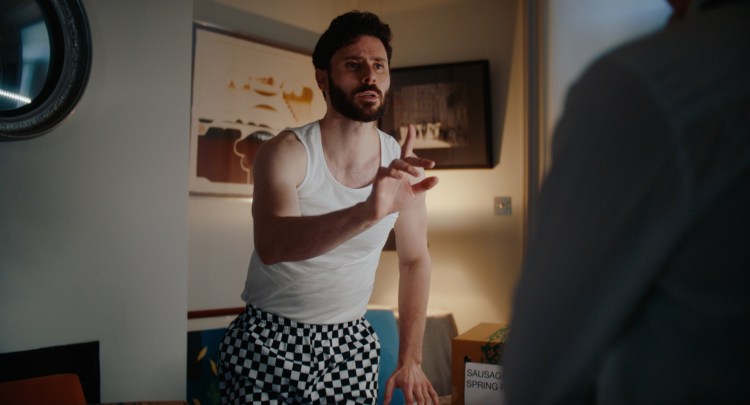
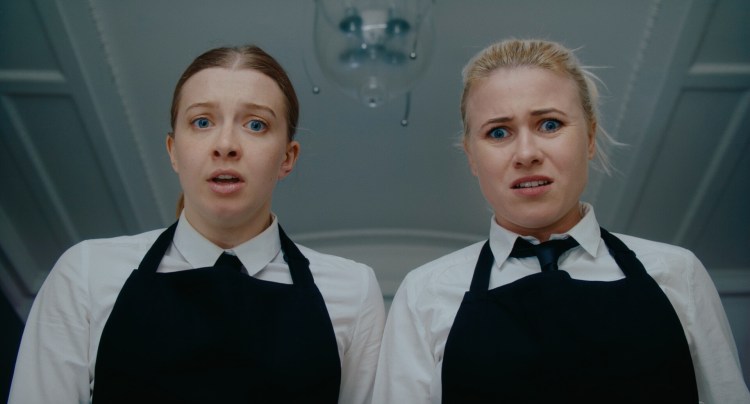
With the three characters for instance, I focused on defining varied dynamics between them. Although the film is only eleven minutes, I also wanted each person to have their own arc in the story. When I first wrote the piece, the waitresses both found Tom the Chef bizarre. However, when I returned to the script two years later, I thought it would be far more interesting and humorous if they had contrasting reactions. I present the audience with two waitresses who seem very close and on the same wavelength, but when Tom the Chef enters, a rift is caused. This is, in my opinion, funnier as it adds that additional layer – an element of surprise; the clash of K’s infatuation with F’s disapproval was so much fun to play with: both to act, and edit. I loved injecting certain reaction shots and toying with the rhythm of specific line deliveries to accentuate the difference.
There is a delicate and fine line in comedy between parody and straight out taking the piss. You manage this delightfully well. How were you able to achieve that balance, and can you elaborate on references you drew from?
I loved the idea of almost having two different realities within the piece, which I think is quite reflective of my brain; one part is very dry, and experiences everything almost in greyscale, the other is heightened and perceives situations through the lens of an epic movie. Quite often I would feel anxious and existential on these shifts, wondering if my acting career would ever get off the ground (I’m still wondering). I was also just a terrible waitress! Subsequently, if I did something wrong, which was frequent, it would feel like a collection of ingredients, organically sourced from self-loathing, had joined together to create the end of the world! I wanted to reflect this through certain techniques like the slow-mo’s and whip pans – they are such useful tools in representing those extreme feelings. The drums also acted as a sort of panicky motif throughout.
I was heavily influenced by the cinematography in films by my favourite directors like Sergio Leone, Tarantino and Edgar Wright. Leone is a master of tension, he manages to make the smallest moment absolutely massive and drenched in anticipation; ‘Once Upon a Time in the West’ is one of my all time favourites, and I loved paying homage to the classic with my own big ‘build-up’ moments. The ‘build ups’ in ‘How Long Have We Got Left?’ however, were intentionally driven by the mundane than say a Western shoot-out.
What did you learn from ‘Smooth Ride’ that helped in the production of ‘How Long Have We Got Left’?
Well…I thought by setting the piece in one room I’d be shaving off a lot of set-up/ moving time. However, I invested in extra kit so we could achieve certain abstract shots. Consequently, the prep for each scene was even longer and more complicated. But I guess, despite still being up against the time, that shows I had grown in confidence as a director and wanted to take more risks with the style of the film. The amount of random challenges that arise when you are filming are unfathomable. In hindsight they’re hilarious, but at the time it’s incredibly stressful. With ‘How Long Have We Got Left?’, we had about two hours left to shoot a massive chunk of the film, and the next-door neighbour began to power-hose their front porch, creating a deafening sound of a spaceship landing. I’d like to think I dealt with freak occurrences like these with a slightly calmer head than I did with ‘Smooth Ride’. With experience, you become equipped with evidence proving there is more often than not a solution. I also received invaluable guidance from the phenomenal crew, especially DP Simona!
I made ‘Smooth Ride’ with one of my best friends Helena Westerman, and she knew how to tackle the editing beast that is PremierePro. So I had the luxury of learning how to edit through Helena. This skill was utilised as soon as humanly possible, after I’d downloaded all of the files onto my laptop. I’d wake up every day, spring into my chair and edit the film until my eyes went square and I had to leave for my teaching job.
Your quick-fire snappy sequences at the start are so effective at conveying the pressure and sheer anxiety of working in such situations. Were those all brought together in the edit?
I’m so glad they had that effect! I intentionally wrote that sequence into the script. As mentioned earlier, Sergio Leone’s impact on me as a filmmaker has been monumental. I find the ‘Once Upon a Time in the West’ opening to be one of the most tantalising and unique in history. The different mini events occurring are just genius – the fly buzzing, water dripping, gate opening – they all create this incredible sound-scape which builds and builds, and a deep sense of foreboding is established from the get-go. This is the atmosphere I wanted to create with the ‘How Long Have We Got Left?’ opening. So I thought about all of the (stress-fuelled) actions I used to do before a shift, and worked on layering them all to reach a crescendo. The combination of Simona’s and Connors’ striking shots, Simon’s sharpening/magnifying of the foliage/clock ticking, Harris’ playful yet nerve-inducing score, and Alice’s quirky animated titles allowed this to all come together: a result of incredible talent and a truly harmonious collaboration.

Can you tell us more about the cinematography and creating that shiny-yet-grey aesthetic which works so well with the comedy.
Connor is a genius with colour, and as he tripled as the focus puller, gaffer and grader, he was an integral part of creating the film’s aesthetic. We discussed leaning into the more clinical appearance of the hospitality industry, the behind the scenes – the kitchens, the uniforms, the cutlery; I wanted it to be quite crisp and sterile. But then there’s also some warmer moments which I feel help showcase the beautiful house we are in. I wanted the audience to understand that we were working at a very high-end event. As Connor had colour graded and lit ‘Smooth Ride’ so beautifully, I had the utmost trust in him; I didn’t have a look at what he had done until he was about 90% in, and it was absolutely perfect – I had zero notes!
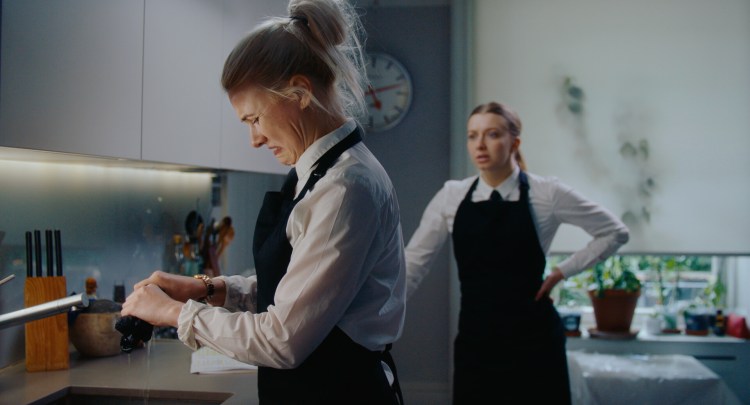
How do you personally balance working both behind and in front of the camera, while keeping objective about both parts of the process?
It might sound really obvious, but I found the most effective way to keep objective, was to just do a tonne of homework. I had three dense documents/packages which I repeatedly drew on to help me become fully immersed in my vision: the story board, the shot list, and my director’s notes. These were developed across the four months of pre-production. So by the time it came to the shoot, I felt like ‘How Long Have We Got Left?’ was a part of my DNA; I knew what I wanted the audience to feel at each point, and I was aware of where the characters were supposed to be in their individual journeys – this enabled me approach the work objectively. There’s no denying, I’d watch playback of my takes and wince, but you have to ask yourself, ‘Has my character reached the objective of that scene?’ If yes, let’s move on ASAP! Additionally, Kat, Tom and I have an amazing rapport because we are so close, and they are also exceptional actors – so that part was not only made easy, but just so joyful.
What do you hope for your film?
I hope to get the film into as many festivals as possible with a look to creating more films within the same world – a mini series of snapshotting more of these unusual encounters!
 Rocks Festivals Blog